A monthly blog about the sensory experience of New York City

Tuesday, August 6, 2013

SOUND: “Sound Journey” in Bed-Stuy brownstone

I found out about the sound journey on a telephone pole on Franklin Avenue, on one of those flyers with the teeth at the bottom that you tear off. “A guided meditation followed by a journey through sounds. Lying down in deep relaxation, experience sounds’ soothing vibrations, energizing presence, and healing power.” I sent an email. Some time later, I found myself climbing a brownstone stoop in Bed-Stuy at dusk, with my yoga mat, a blanket, and a pillow tucked under my arm. I rang the bell.

A gray-ponytailed man in shorts opened the door, introduced himself as V, and ushered me into his parlor apartment. The large room was empty but for some plants, a piano, and a futon couch pushed against the wall. Recorded relaxation music played; the air was heady with incense. The other participants had unrolled their yoga mats on top of two Oriental rugs. 

In one corner a middle-aged man reclined on a slab of egg-crate foam, his head resting on a stack of books, a set of prayer chimes by his ear. A young Asian woman next to me lay in shavasana. Through some doors at the back, I could see V.’s bed and a dozen or so crystal and metal Tibetan singing bowls of varying sizes set on little pads. They caught the light of the colored LED candles flickering on top of the piano. V. slid closed the pocket doors to the lobby and announced the beginning of our sound journey.

He invited us to lie down, close our eyes, and remain completely still as we concentrated on each part of our bodies, from our toes to our ears. V.’s footsteps padded across the floor, then the drones of a didgeridoo filled the room, interspersed with snuffling as he replenished his breath. The honking twangs—unlike any other instrument—was transporting, but in my prone position I felt a little like I was being vacuumed around. Squinting, I saw that as V. played he was actually creeping between our yoga mats like a pied piper in a T-shirt. There was no room for thought: the reverberations resounded even into the floorboards.

Over the course of about an hour, the didgeridoo flowed into drumming, clattering pieces of wood, rustling tissue, bells, and the gongs and keening hum of the singing bowls. As he moved around the room, sometimes V. played the instruments to the soles of our fee, and I felt the music there like a tickle.

As the waves of sound washed over us, the only reminder of our location in brownstone Brooklyn was the creaking of the parlor floorboards under V.’s bare feet and, once, his neighbors clattering up the stairs. At the end, an ice cream truck passed by outside, and the minor shift of its fading music wove into V.’s final, ethereal singing. 

I opened my eyes; the room was darker now and felt more intimate. A gray-haired woman stretched her arms over her head and announced, “I feel full of vibrations! “Another woman sidled up to V. and asked him how she could summon more sound from her own singing bowls. I helped myself to some Brita water, in a plastic cup decorated with balloons.

On the futon couch, V. had unveiled the instruments of our journey, but I averted my eyes, content to imagine what they might have been.

I thanked him and found my car outside. As I was about to pull away from the curb, though, another car pulled up beside mine, windows down, music thumping. A man hopped out and began chatting with two men enjoying the evening beneath a tent in their brownstone courtyard. I called out my window, “Hey, I’m about to pull out. Could you move your car up?” The guy slunk back to his car, leaned in the driver’s side, and shouted to someone in the passenger seat, “Hey, can you move this shit up?” With a squeal of tires the car lurched forward. The windows went up, muffling the music.

Tuesday, July 2, 2013

SIGHT: Seven random delights


In Sense & the City annual tradition, I offer seven sensory delights for the seventh month.

1. Neighborhood tree fencing

This replica of the Brooklyn Bridge is outside Ted & Honey Café in Cobble Hill.


2. Peeled pineapples cut into spirals

Beside their fully clothed neighbors, they look at once flamboyant and vulnerable, like a woman in eveningwear on a morning subway.


3. Spools of thread in streetside tailors’ windows

The tidy spools of every hue mounted on a pegboard encapsulate New York’s quick-fix economy. 


4. Fire hoses at the New York Public Library and Grand Central Terminal

Coiled behind a grillwork cage and shuttered in a wooden cabinet: like everything else at these institutions, immaculately designed.


5. Mail-carrier instructions

Lest there be any confusion. President Street, Brooklyn.


6. Chase Bank, Brooklyn Heights

Classic and imposing, the way a bank ought to be. 


7. Subway-platform candy stands

Nowhere else do nuts, candy, chips, and batteries look as beautiful as on a gray subway platform.


Tuesday, June 4, 2013

TOUCH: Conch umbrellas

You know the kind of umbrella I mean. 


New Yorkers call it “the five-dollar umbrella,” but it’s usually four dollars if it’s not raining and six dollars if it is. This is the black umbrella with the beak-shaped handle, the kind that materializes for sale in buckets outside subway entrances and at pop-up sidewalk stands just before a rainstorm, and disappears just as swiftly. In their wake, these umbrellas leave a jumble of broken aluminum spines jutting out of curbside trashcans.


Unlike West Coast cities, New York is an umbrella city. New Yorkers refuse to compromise fashion or risk dampness by wearing parkas or hooded raincoats. The only solution is to wear what you’d normally wear, and carry an umbrella to protect it. But often rainstorms catch us by surprise: the day starts bright and sunny, but around 2 p.m. rainclouds threaten and we realize, with a certain amount of desperation, that we don’t have an umbrella. That’s where Conch umbrellas step in. For practically pocket change (bargain!), anyone can buy a temporary shelter from unexpected downpours, and one is virtually guaranteed to find a Conch umbrella within a few blocks. 


Conch umbrellas are made in China by Elite America Corp. and distributed from a warehouse in Bushwick, which also houses a showroom featuring the brand’s many rain-coverings, from raincoats to patio umbrellas to personal umbrellas (including the popular but unsightly stick umbrella with a collapsible white plastic sheath that sits like a cup on the tip). 


The local favorite, however, Conch has dubbed “Man’s regular umbrella.” It’s about a foot long, and its textured, curved handle provides a secure grip in slippery, windy weather. With the press of a silver plastic button, the Conch unfolds in a double whoosh, as the carriage slides up the rod and the ribs spring open. As you’re waiting to cross the street, you can fiddle with the wobbly ribbed collar above the handle. 


Since the Conch umbrella is made of cheap nylon, and the ribs are attached with flimsy double cotton threads, New Yorkers learn to aim it headlong into wind that’s coming toward them, and to tip it behind their heads when the wind is coming from behind. If held straight overhead, the Conch is likely to get blown inside out. Though this can happen to any inexpensive umbrella, the vacuum-like sensation of the Conch’s undoing is preceded by an ominous trembling in the center rod, and despite attempts to pull down on the carriage, there’s no going back. Indeed, some might say you can identify a native New Yorker by how he handles his Conch.


It does seem fitting that in this city we choose the abrupt separation from our surroundings that umbrellas offer as opposed to the oneness with the elements evinced by our West Coast friends. Conch umbrellas are cheap, disposable, and satisfying to hold. Their ubiquity is comforting. And as we see our fellow New Yorkers wrangling with their Conch umbrellas in a spring storm--aiming the inverted cups into the wind in the hopes of blowing them back to shape, bearing them like swords to blaze a path down a crowded sidewalk, raising and lowering them as they pass beneath scaffolds with seamless choreography, hurling their broken ribs into the trash--we feel solidarity. Protected from our surroundings, we unite with them, much like a conch in its shell, drifting over the rocky shore.


Wednesday, May 8, 2013

MULTISENSORY EXPERIENCE: Dream House

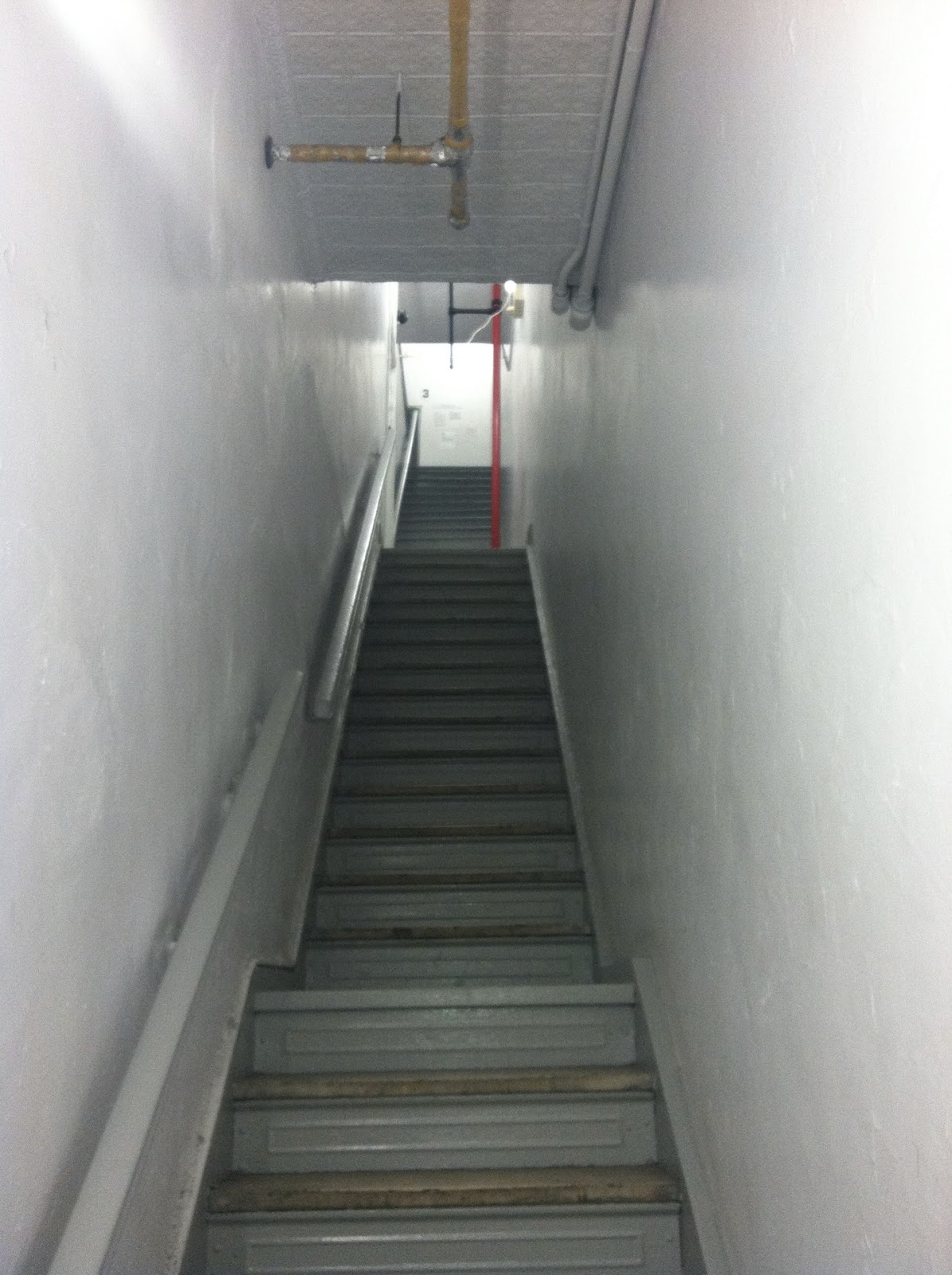
The mind-altering experience of Dream House, a “sound and light environment” in a Tribeca loft, begins before you enter and continues well after you leave. As soon as I was buzzed through the door of 275 Church Street and began the climb to the third floor, I heard the humming, felt the pulsing, smelled the incense, detected a pink cast to the stairwell light. 


At the top, I removed my shoes and set them beside a Penguin Classics tote bag, a tweed hat, an overcoat, and a pair of battered shoes. I imagined a lone professor bumbling about inside. Instead, when I stepped through the door into the violet light and trancelike sounds, I saw a lithe young couple embracing, surrounded by dingy pillows strewn across a musty wall-to-wall carpet. I felt as though I’d entered the bedroom of a rebellious teenager.


Behind them, windows covered in magenta gels tinted the city skyline pink. An altar featured a propped-up painting of a yogi-type howling at a cloud, incense burning below him in a blue cereal bowl. The air was hot and swirled with incense smoke, and the sound (not quite music) pulsed and droned and throbbed. The subtle pitch changes penetrated to my core.


The Dream House, conceived by composer La Monte Young and visual artist Marian Zazeela, has inhabited this space since 1993. The duo describes it as “a time installation measured by a setting of continuous frequencies in sound and light,” which is hard to conceive of until you are in it. It’s sort of like being inside an electrical outlet where a rave and a meditation session are taking place simultaneously. The sound, which Young created using a Rayna synthesizer, consists of a constellation of thirty-one frequencies that create unique intervals. “[It is] highly unlikely that anyone has ever heard them or perhaps even imagined the feelings they create,” he notes in the installation’s press release.


Not wanting to disturb the couple, I retreated down a neon-lit hall to a second, smaller room. As I moved through the space, the sound changed, becoming shrill with a pounding undertone, sort of like being on a motorboat bouncing across waves. I felt lugubrious yet weightless. I sat on a pillow and contemplated the illuminated shadowbox hanging on the wall before me. 


After waiting a tactful few minutes, I made my way back to the main room. The guy was now seated in the lotus position on a pillow, pressing his finger to his third eye. The girl, in a yoga posture, stretched her arms toward four comma-shaped mobiles, which, illuminated by theater lights fitted with gels, cast luminous red and blue shadows on the walls. Then she dropped to the floor and began to crawl down the neon hall. The guy pressed his hands together in prayer, bowed, then reclined on a pillow, gazing at the ceiling. Nothing moved, not even the mobiles.

When I stepped onto the sidewalk, an incense perfume seemed to permeate the air and my ears tuned in to frequencies I wouldn’t have noticed otherwise: the snores of a Verizon truck intubated to a manhole, the hum of vacant subway tracks, the fuzzy sub-beat of a fellow passenger’s headphones, a distant, sourceless harmonica.