A monthly blog about the sensory experience of New York City

Showing posts with label multisensory. Show all posts

Thursday, April 15, 2021

MULTISENSORY: Ramblersville, Queens: New York's smallest neighborhood


Welcome to Broadway, in Queens, New York. 


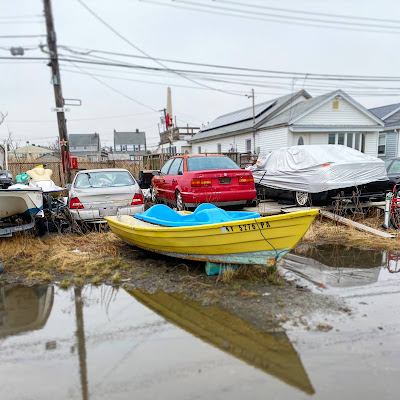
Though each of the five boroughs has a Broadway, this one, in the tiny nautical hamlet of Ramblersville, is about as far as one can imagine from the spinning lights and hot dog steam of Times Square. At the intersection of Broadway and Church Street, boats are parked alongside pickup trucks, and the air smells like tar paper, damp wood, and seaweed.


Ramblersville, also known as Hamilton Beach, is arguably the smallest neighborhood in New York City. It comprises three spits of land, wedged between Howard Beach and JFK International Airport, that reach into a hooked strip of water known as Hawtree Basin, which joins Bergen Basin and Shellbank Basin to flow out into Jamaica Bay. 

Water is a way of life here. All Ramblersville streets dead-end in Hawtree Basin, and bridges crisscross the canals. On a weekend afternoon in early spring, the air fills with sounds that could be from another era: the cawing of seagulls; the hollow hammering of a men patching a wooden dock; dogs barking at front doors, leaving nose streaks on the storm glass; and mothers calling to their kids, who zizz past on on bikes, weaving between the cul-de-sacs.

Many of the houses are raised on pilings over the water, and ducks, swans, and geese drift just a few feet below living room floors.

Ramblersville is a neighborhood of rainbow whirligigs and patriotic flags, of Easter and Saint Patrick's Day decorations and mailboxes shaped like churches, barns, lighthouses, or sometimes all three. 


Though planes from JFK rumble close over rooftops and the A train rattles past just yards from the doorsteps (the gleaming Howard Beach AirTrain station is a short walk away across a marsh), this neighborhood feels out of step with urban life. One street, Bayview Avenue, is a wooden boardwalk flanked by picket fences. 

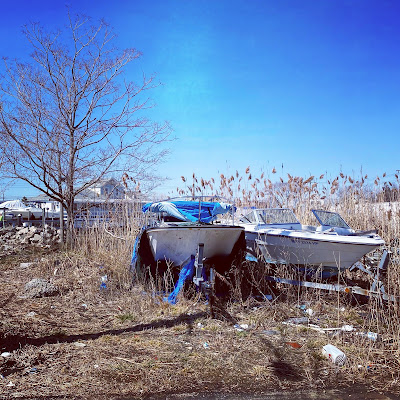
Boats are ubiquitous: parked on trailers in driveways, bumping against docks, belly up by the sides of roads, and stashed in vacant lots surrounded by beach grass.


If the chickens in this yard were to take flight, 


they'd see the sparkling waters of Jamaica Bay connecting this sleepy neighborhood to the world.


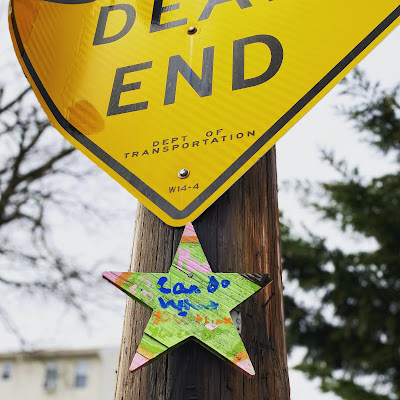
Beneath each of the Dead End signs along 104th Street—which is as close to a Main Street as Ramblersville has, despite its Broadway—some local children have tacked wooden stars painted with inspirational messages. Most have faded in the sea breeze, but one message is still visible: "You can do whatever you think you can." This seems an apt reminder that there is always more to explore in New York, even when you think you've come to its end.


Friday, January 10, 2020

MULTISENSORY: Luxury Escapism: a virtual reality spa

It's true that at Luxury Escapism, a new multisensory spa in DUMBO, you'll find waffle-weave robes, dim lights, and a decanter of cucumber water.


But in place of lavender eye masks, you'll find electronic goggles called "eye massagers." In place of massage tables draped with towels, you'll find vibrating beds with gravity blankets. In place of almonds, you'll find Hi-Chew "intensely chewy candy." In place of new age music, you'll find a "sonic sauna." And in place of flickering candles, you'll find strobe lights and virtual reality goggles that transport you into geometric projections of infinity.


"I feel like I'm in a cross between West Elm and the Sharper Image," my companion whispered as we padded around the basement space in our courtesy slippers and robes. The pink light notwithstanding, the room—divided into eleven experiential zones—had that familiar millennial immersive-experience vibe: all tactile surfaces and activity stations and, arrayed on every surface, VR goggles. Here was self-care with a thrumming bass line of tech. It goes without saying that the entrance to Luxury Escapism is through an unmarked basement door.


However, even though the spa advertises its Instagram handle on its postcards, the posing-and-posting impulse is held in check by two ground rules: no phones and no talking above a whisper. (I got a press pass.) Instead, the spa promises to connect you with the present moment through "technology that actually feels good." If you're expecting a facial and a hot-stone massage, you've come to the wrong place—though there are faux hot stones set around an electric campfire.


On the night I visited, the ten or so other spa-goers were mostly young couples who seemed thrilled by a novel New York City date night. And while it is true that (as far as I know) there is no other place in New York City quite like this, our expectation of novelty—foundational to the immersive and pop-up experiences that abound these days—is becoming increasingly familiar.


Goggles of many sorts abound at Luxury Escapism. I decided to begin in the Yogibo Lounge, where I picked up my first pair: an electronic eye-massaging mask. It felt sort of like a blood pressure cuff inflating and deflating over my eyeballs while emitting wheezy puffs. A set of VR goggles catapulted me into a 3-D jungle; thankfully, the comfortable Yogibo beanbag kept me grounded. Soon an attendant beckoned me to "Rainbow Therapy," one of the spa's two timed experiences.


I lay down on a water bed and closed my eyes. The room darkened and the bed began to convulse. Strobe lights pulsed through my eyelids. Though I could control the intensity and vibrations, I felt a panic attack coming on. To stay sane, I silently chanted the mantra, "I am healthy and fit. Probably I will not have a stroke."


Next, I ducked into what would be my favorite experience, the Kinetic Sand Dome, a yurt with kinetic (moldable) sand, scoops, and slicers. The tactile experience was heightened by—goggles! But these were a non-VR pair with a lens that somehow separated my hands from my body. As my friend put it, "I feel like I'm watching an instructional video of myself in real time."


The next stop was called Lux TV: a couch in front of a TV showing grainy footage of ASMR installations, and a table of fidgets to calm your hands.


As my friend and I were playing in the Sound Stones playpen—a gravel-floored space outfitted with simple, childlike musical instruments and a headset you could use to manipulate the sounds—we were called into the Sonic Spa, the second timed experience. After the door closed on the small, windowless room, we plunged into total darkness alongside several strangers: panic attack #2. But then the soundscape began—a melange of birdsong, sticks breaking, snow crunching, cicadas. The darkness ended up being a welcome break from the audiovisual input.


VR goggles had greeted me at nearly every turn, from the Fuzzidarium, a room swathed in white fur; to a pair of hammock chairs; to the vibrating beds of the Senscape, where I took a float down a virtual stream; to the Cosmic Steam Room, where, using hand gestures paired with goggles, you could manipulate images projected on a scrim.


As the two hours were nearly up, I decided to cleanse my sensory palate with a Hi-Chew, one of those candies that is simultaneously stressful (it's claustrophobic! it fills the mouth entirely and sticks the teeth together! it seems it will never be swallowed!) and satisfying (the burst of fruit flavor! the teeth-sinking texture! the intensity!). For the forty-five seconds it takes to consume one, you can think of little else: it forces you into the present moment.


So it was for me at Luxury Escapism. Then I swallowed a paper cup of cucumber-infused water and the candy was gone.

Thursday, October 10, 2019

MULTISENSORY: Urban forest bathing


The buildings of Central Park West rose beyond the treetops as Brooke Mellen, the owner of Cultured Forest, a local forest bathing and nature therapy group, instructed us to face each of the four cardinal directions. "Which one feels best?" she asked. This was the opening of what would be a two-hour session of shinrin-yoku, or forest bathing, in a setting far removed from the practice's roots in 1980s Japan. To me, the most comfortable direction was west, toward the city, with the sunlight on my left arm.


I admit that when I first heard the term "forest bathing," I pictured myself splayed on the forest floor, gazing up at the treetops, or perhaps sprawled facedown, nuzzling into a bed of moss and pine needles.


So I was surprised to find that, at least in the United States, forest bathing includes few moments of rest. As described by the US-based Association of Nature and Forest Therapy, here shinrin-yoku is "a practice of developing a deepening relationship of reciprocity, in which the forest and the practitioner find a way to work together that supports the wholeness and wellness of each. In forest therapy, there is a clearly defined sequence of guided events that provides structure to the experience, while embracing the many opportunities for creativity and serendipity offered by the forest and the individual inspiration of each guide." 


As we concluded our opening ceremony, peals of laughter and waftings of palo santo incense drifted toward us from a nearby group of French picnickers. Rather than feeling annoyed, I smiled at the thought of this group engaging in their own form of forest therapy, albeit with wine and cheese. 


Next, we stopped at the junction of two paths. Brooke had us reach into a bag of stones and select one to infuse with good intentions for the person across from us. Mine was prickly and glinted with mica. We squeezed our rocks and tried to exchange them without opening our eyes. My partner and I crashed into each other, but succeded in passing off our stones. Hers was still warm from her hand.


We strolled on to our next location, observing the movements in the park around us. A dog leaped to catch a squeaky ball. Chipmunks rustled in the underbrush. Bees hovered over flowers. A topless man did calisthenics on a picnic blanket. As usual in the city, everyone was doing their own thing, but on this fall day their disparate activities seemed to be in sync.


Brooke led us to a secluded grove, where she encouraged us to spend ten minutes immersing ourselves in the forest. Aha! Forest bathing at last. I found a slab of Manhattan schist and lay on my back, inhaling the tannic scent of early autumn and letting the breeze wash across my face.


My reverie did not last long, however, as three men emerged from the trees lugging bulging trash bags. They were soon followed by a man on a bike. "What y'all doing here?" he chastised one member of our group. "I was smokin' some weed--or I was about to smoke some weed till all y'all came along!" As it turned out, he was a forest bather himself, though perhaps not by choice. The eye of his tiger-print blanket glared out at me from beneath some trees.


After a few more activities, including communing with a tree and throwing stones representing our burdens into a waterfall pool, Brooke had us create Andy Goldsworth–esque art installations in the woods. As I rooted around the forest floor, I kept coming across pieces of litterfour blue cigarillo sheaths, a Magnum condom packet, sublingual film for narcotics overdoses, a Honey Bun wrapper, nickel bags. All seemed to be tokens of the ways humans escape from themselves and their surroundings. 


Rather than reject the detritus, I decided to incorporate it into a mandala to honor the dark underbelly of the city's woodland. Brooke had told me she sometimes arrives ahead of the session to pick up litter from each of the sites, but in this case I was glad she hadn't. Even if the point of forest bathing is nature appreciation and contemplation, it seemed disingenuous to ignore the reminders of our urban setting.


Our last stop was a boardwalk overlooking a burbling stream, where Brooke unveiled a forest-themed tea ceremony from her backpack, including a thermos of dandelion tea and a box of maple leaf sandwich cookies. She passed around a balm made from hinoki cypress, native to Japan, to rub on our wrists to stimulate our sense of smell. Then she sang a heartfelt rendition of the Beatles' song "Blackbird," her voice mingling with the rushing water. An elderly birder with binoculars around his neck paused to listen, smiled, and mentioned a wood thrush he'd spotted near the stream, another urban forest bather making the woods his own.


Wednesday, September 11, 2019

MULTISENSORY: A two-vine winery on a Carnegie Hill brownstone rooftop


When Latif Jiji was twelve years old, he would pass by his father’s wine barrel near their kitchen in Basra, Iraq, lift the lid, and inhale. Seduced by the scent, he sometimes dipped in a finger and licked the juice from his fingertip. (His father, an amateur vintner, hadn’t yet figured out that wine should not be stored in containers with loose covers.) “That was the origin of my daring to repeat it. It’s all based on feeling, intuition,” Latif, now in his nineties, says.


Those stolen moments were the sensory spark of Chateau Latif, Manhattan’s only vineyard and winery, which evolved by accident in the backyard of his family’s Carnegie Hill brownstone. “I’m not really into fine wine tasting or anything like that,” he says. “The taste of my father’s wine is the one that has stayed with me.”


In 1977, Latif snuck a Niagara grapevine into his garden, which had previously been his wife’s domain. Then he sort of forgot about it. But seven years later, after he returned from a summer vacation, he noticed that it had grown to about fifteen feet long—and had started to produce grapes. 


Excited by the prospect of re-creating family history, he decided to harvest the fruit. The first crew, in 1983, was just Latif and one of his daughters; no wine was made that year. Soon after, he planted a sprig from the first vine to create a second. Together, the twin vines, now more than one hundred feet long, have climbed the back wall of his four-story home and sprawled across a rooftop arbor in an urban terroir of bitumen roofing, AC compressors, and water tanks, and with a view of skyscrapers.


Chateau Latif produced its first fifteen half bottles in the second harvest, in 1984. Though wine from the early years is drinkable, he didn’t know enough about proper corking those first years. He has saved these bottles for posterity in his wine cellar, a hobbit hole in the front of his basement. 


A retired engineering professor, Latif is always making improvements, but Chateau Latif’s operation is decidedly homespun. His vines are watered by urban rainfall and city water, and he prunes them only once, in winter. In 2019, he harvested four hundred pounds of grapes, which will make eighty bottles of white wine. On harvest day, around Labor Day, about thirty friends and family members—including Latif’s children and grandchildren, who all live in Manhattan—will gather and work from morning till early evening. The process starts with a climb up Latif’s defiantly steep staircase to the roof, where a hatch leads to the arbor.


In most vineyards, the vines are only five or six feet tall, so harvesters do not need to snip grapes upside down, standing on benches and milk crates, as they do at Chateau Latif. But here the crew is rewarded by a panoramic view of the Manhattan skyline.


The crew shuttles them down the back wall of the brownstone in a plastic laundry basket, using a pulley system.


In the backyard, the harvesters receive the grapes, weigh and wash them, and feed them into a manual crusher and de-stemmer. Children love to turn the crank and watch the stems move to one side of the de-stemmer and fall into a bucket.


The grapes then go into a wine press lined with netting to extract the grape juice. The first sweet squeezes of Chateau Latif wine ooze out the sides.


They pour the juice into five-gallon glass jugs and add a precise amount of metabisulfite to kill the natural yeast. A measured amount of yeast is then added and fermentation begins in a day or two. Fermentation ends after about a week, and the jars are topped off and sealed with airlocks to let gases escape but no air can enter. The jugs are stored in Latif’s ingenious wine cabinet, constructed of insulation boards and cooled by a mini-fridge with the door removed.


Using a back issue of the New Yorker and school glue, Latif attaches the signature labels. They are hand-watercolored by family and friends and feature an image of his brownstone with the roof arbor atop and legendary vine trailing down the side.


He seals the bottle neck with a plastic heat-shrink capsule over his kitchen stove burner.


“My goal is not to make the best wine but to have a story,” Latif says. Is it a stretch to say the 2018 vintage tastes of the Second Avenue subway, the pleats of private-school uniforms, glazed Dunkin Donuts, the metal chains of a playground swing set, dry cleaning, and the wax-and-wood of Brick Presbyterian Church—all in the vicinity of Chateau Latif’s vines? Perhaps, but that it tastes most of is family and history.