A monthly blog about the sensory experience of New York City

Monday, March 4, 2013

SMELL: Chelsea Flower District at dawn on Valentine’s Day

It’s 5 a.m. in Midtown on Valentine’s Day. The only sounds are the buzz-click of changing traffic signals and the swish of a stray cab through puddles. The sun won’t rise for another hour or so.

But turn onto West Twenty-eighth Street between Sixth and Seventh avenues, and the scene changes abruptly. This is the hub of the Chelsea Flower District, and even though the shops are wholesale-only, anyone can wander in--alongside the city’s flower dealers--to begin the day as they do: with a fragrant oxygen rush.


There’s the splat of a bucket of water hitting the sidewalk, the beeping of delivery trucks. Workers hoist bunches of pussy willows and branches into tubs on the sidewalks. Inside, the shops’ wall-racks explode with every conceivable color and type of flower, like psychedelic wallpaper.


I step through the door of Empire Cut Flowers. As it’s Valentine’s Day, roses are front and center. I smile to think of the journeys these bouquets will take from here: into buckets outside bodegas, or wrapped in parchment paper and ribbon, carried on the B train or protruding from a messenger’s bag, presented over dinner at Daniel or on a stroll in Central Park.


The moist green rush of perfume and cut stem hits me instantly—a sweet-and-sour, living smell. But a few steps in, the scent of roses and mingled buds is quickly overwhelmed by other smells: drip coffee (which is available for all in the back of many of the stores, alongside flats of doughnuts and sodas); cologne and body odor; the mustiness of wet cement floors and air conditioning; the astringency of eucalyptus.


Salsa music plays, and morning news radio. A spirit of camaraderie prevails as the dealers greet many customers by name. There’s an undercurrent of instructions and consultations, in Spanish and English—“Twenty-five cream and two long-stems…” “Empire doesn’t have it, check…” “I got some nice delphinium, some daffodils, nice bunches, pink, red, orange…” but no one seems rushed. There’s the crush of empty cardboard boxes as the flowers gradually move off the shelves and out of the store.


Daffodils rest supine, not yet bloomed, in a box. Lavender bundles exude a dry, heathery aroma from beneath a metal shelf. Vats of tulips burst from their wrappers beneath vases of early spring branches. Ranunculus buds rest their heads on a bed of shredded paper. Calla lilies—one of the few unbundled blooms—tempt passing noses with the flute of their single white petal.


A streetlight glows where the sun will rise in an hour, and the asphalt is littered with crushed flower stems and petals, like a gym floor after a prom. A Dutch Flower Line truck disgorges boxes that landed at JFK just a few hours ago.


On my way home, I stop into a Duane Reade. Bouquets of a dozen roses are $17.99. I carry one to the register. “These roses are, like, eighteen dollars,” the clerk says, waggling the bouquet in one hand and raising an eyebrow. “I mean, yesterday they were only twelve dollars. Is it worth it?” he asks.

I decline: I am carrying a bouquet within me, and the day hasn’t even begun.


Tuesday, February 5, 2013

TASTE: New York City tap water

New York is reputed to have the champagne of tap water. The crust and loft of our bagels and pizza crust have been attributed to its properties. At restaurants, when given the option “Bottled or tap?,” seasoned New Yorkers choose tap without hesitation, and in some spots a carafe of local water is part of the place setting.


I decided to sample New York’s miracle beverage in three forms: straight from my Brooklyn tap (free), from a plastic bottle of Duane Reade’s “New York Spring Water” ($1.56), and from a glass bottle of Molecule Water Project’s ultra-purified tap water ($2.50).


At home, I let the tap run cold, then filled up a glass. The water was clear and smooth with a faint bitterness that turned to sweetness before dissolving. The water was refreshing, clean, and utterly forgettable: exactly what most of us are looking for in a glass of water.

Duane Reade, the iconic New York drugstore, sells its “New York Spring Water” in a plastic bottle with the bar code shaped like the Statue of Liberty. The back of the label states: “Bottled in New York State, for New Yorkers.” The front of the label reassures skeptics and tourists: “It’s clean, it’s natural, we promise.” Duane Reade’s water was crisp and had a resinous tang, but overall it went down pretty easily. I felt energized and refreshed, perhaps because it was chillier than even the coldest water I could summon from my faucet. 


Finally, I went to the East Village storefront Molecule Water Café: a slice of prime Manhattan real estate—gleaming tile, wood counter, bay window—devoted to one thing: selling purified tap water (as well as filters for faucets and showers).


Molecule’s water passes through a twenty-five-thousand-dollar machine that subjects it to an eight-stage process involving ultraviolet light, reverse osmosis, and ozone treatments to rid it of all impurities (chlorine, fluoride, and lead, among others). It costs $2.50 for a sixteen-ounce glass bottle with a tin cap. Molecule recommends drinking water at room temperature so the body doesn’t have to exert as much energy. The handsome packaging, the satisfying glugglugglug as the water passed through the neck of the bottle, and the texture of the glass lip contributed a sense of value, but the water itself tasted the least smooth of the three. Though I’d heard Molecule’s purified tap water described as “velvety” and “round,” I tasted lemony and floral notes, and a decidedly bitter aftertaste that lingered, unlike the previous two waters.


One wall of the café features a row of glass tubes filled with colored liquids. For a dollar or two more, you can supplement your tap water with alkaline and electrolytes, vitamins, or one of several “Signature Blends”: luo han guo and shiitake mushrooms for immunity; biotin and grape-seed extract for hair, skin and nails; holy basil and white willow bark to counteract inflammation; and ashwagandha and rhodiola for energy.


In addition, there are “Suggested Combos” to take the most vigorous New Yorker from dawn to dusk: “Fountain of Youth” and “Body Repair” to get you out of bed in the morning; “Strong Bones,” “Cold Buster,” and “Glamour Shot” to transition from work to a night on the town; “Base” and “Night Vision” to help you keep your bearings; and finally  “Relax,” “Recover,” and “Hangover” (the most popular combo).


I decided to try “Molecule Energy” ($3), a “unique blend of herbs, fruits, and roots from around the world” that promises to “sharpen your mind and enliven your body so you can get out there and carpe diem.” The water in my glass bottle turned a murky green with sparkly sediments. It tasted like weak green tea. After a few sips, I did feel a tingle of replenished energy. Could it have been the caffeine anhydrous? The guarana? Or maybe it was the alchemy of a quaint café, a designer bottle filled from a test tube, and faith that if tap water could be transformed for three dollars, so could I.

The Molecule Water Project is located at 259 East Tenth Street. Readers might be interested to check out The Tastes of Drinking Water, about a table correlating the varying tastes of drinking water (“fishy,””grassy,” “cucumber” water to the particular organisms it contains.

Monday, January 7, 2013

TOUCH: Korean body scrub

In Sense & the City annual tradition, the first post of the new year is devoted to a sensory cleansing experience. This year I chose to cleanse my touch faculties with a traditional Korean scrub, meant to slough off layers of dead skin (ddae) and, some claim, the existential baggage accompanying it.

I chose Koreatown’s no-frills Zen Spa & Sauna (formerly known as Yi Pak Spa), recommended by several Korean American New Yorkers as the most “authentic” experience. For one not in the know, it would be easy to overlook Zen Spa & Sauna as yet another Midtown day spa, with its generic name, sidewalk placard, and flyers featuring orchids and bamboo. In fact, the spa’s sign abuts a sign for “99¢ fresh pizza,” giving the impression that body scrubs and “2 slice & can or water” can be had simultaneously.


In the dressing room, my ajumma, a Korean woman dressed in black yoga pants and a tank top, greets me and offers me a perfunctory towel (every time I attempt to use it, she yanks it off) before leading me to a lukewarm steam room. I am the only customer in sight. The room begins to fill with spurts of steam that smell distinctly like boiled celery. I shiver as I watched the cardinal-themed wall thermometer climb from 98 to a still-tepid 110 degrees.


After ten minutes of steaming, my ajumma—who now has her yoga pants rolled up to her groin—leads me to a tiled room outfitted with a plastic-sheeted table, where she tells me to lie facedown. Beneath the spigots on the back wall, steam issues from a row of plastic garbage bins brimming with water, colored bowls floating on top. “Too strong you let me know,” she chirps by way of introduction, then tosses a few bowls of scalding water over my back. My skin flinches at first, then begins to throb pleasantly. She dons two blue plastic mitts (which look like they might have originated in a housewares section), lathers up, and begins to scrub.


I feel like a piece of furniture being sanded: she approaches the scrub not as a fine woodworker exposing the hidden grain but like a carpenter readying a two-by-four. She pins me down with one hand as my body rocks beneath her mitts; the sensation isn’t painful, but it isn’t relaxing, either. The rasping echoes off the tiles. After five minutes, I am becoming chilly, but just in time she douses me with another bowlful of hot water. This is such a relief I almost tell her to skip the scrub and just throw water on me for an hour. But the mood here is one of industry, not pampering, as she flips me up and down and side to side. At one point she announces, “Lots of dead skin!” and I peer from beneath the head towel to see a few graying curls—not unlike eraser crumbs—accumulating on my arm. I had sort of hoped to see drifts of ddae piling up around the table, like when I got my carpets steam-cleaned and the Sears guy kept coming back to brandish the vessel of tainted water.

The exfoliation continues, the silence in the room punctuated only by the susurration of her mitts and the splats of water hitting the tile floor. Finally I feel squirts of melon-scented lotion followed by warm oil trailing across my skin. As her hands pummel my shoulders, I nearly slide off the table, but she catches me and pushes me up into a seated position, where I find a bowl of lukewarm milk resting between my knees. She points. “Wash face.” I dunk my face a few times and looked to her for approval, milk dribbling down my chin. She nods, then pours the remaining milk over my body. She hoses me down from one of the spigots like a child just returned from the beach and pronounces, “Scrub done.”

Finally, I lie in a cold sauna, my head resting on a wooden-block pillow, waiting for the feeble heater to warm up. A few items of clothing have been hung to dry on the railing. In the dressing room, I notice the rug features a purple zipper half-undone.


Peeking back into the spa, I see my ajumma—who has changed her yoga pants for a pair of black underpants--on her hands and knees, scrubbing the tile floor with the same relentless urgency. She flashes a smile, then bends back to her work.

Tuesday, December 4, 2012

TASTE: Roasted chestnuts

The Rockefeller Center Christmas tree is up, and Midtown—that hub of New York City holiday fanfare—is starting to fill with its yuletide smell of pine needles, wet wool, hot-dog steam, mingled perfumes—and roasted chestnuts, the quintessential holiday treat, available around an open fire or, if you’re an urbanite, from the same street cart that peddles pretzels and Gatorade.


The city’s fleet of diminutive orange “NUTS 4 NUTS” carts plies street corners year-round, copper pans brimming with oily mountains of honey-roasted cashews, coconut bits, almonds, and peanuts. Chestnuts, however, are available only in the colder months, and are harder to find.


There are usually a few carts stationed near Fifty-Third Street and Fifth Avenue, their tinfoil-lined chestnut pans clipped to the edge like a hand on a hip, an incandescent bulb keeping the nuts warm. [image 2] The flashiest chestnut cart features no fewer than five sunshades and a digital sign scrolling, in mid-November, HAPPY NEW YEAR!


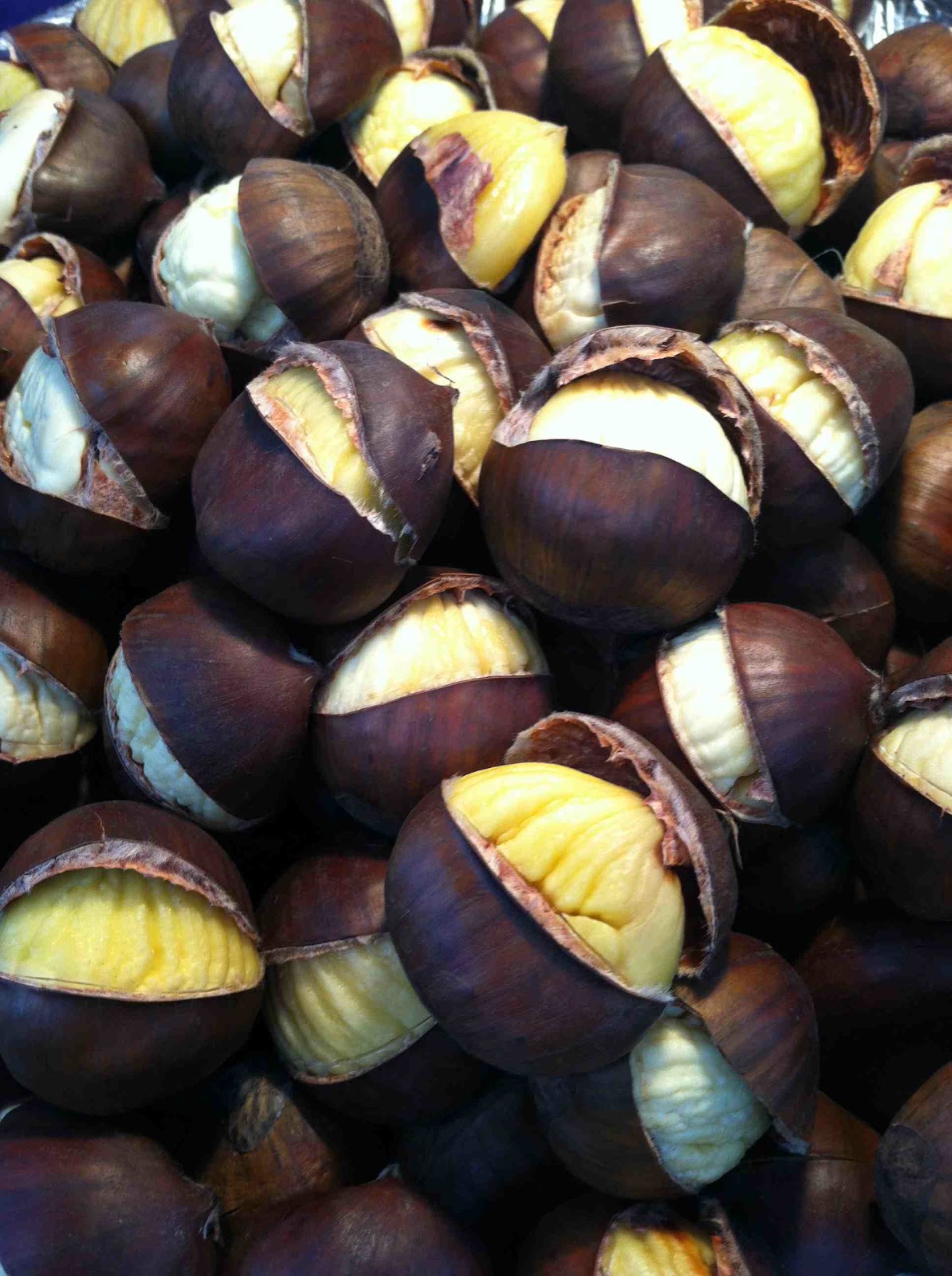
Vendors slit the chestnuts’ outer skins, then roast them till the yellow nutmeats peek out like grinning gnomes. Five dollars buys you a scoop in a paper sack. It’s worth postponing your snack to carry the bundle around in your pocket for five minutes, enjoying the warm orbs tumbling around beneath the paper.


The nutshells are smooth and woody, and as satisfying to peel as mahogany veneer from an old end table; the shell slips off with a papery crackle. You can take the whole nut out, or bite into it while it’s still half in its shell pocket. The meat is dense, sweet, slightly rubbery, and drier and more grainy than most nuts; it lacks the oil of a cashew or peanut. Laid bare in the palm, the nut is fleshy, wrinkled, and vulnerable looking, its interstitial crevasses creating a pleasing pop with each bite.


Be warned: a few roasted chestnuts go a long way. Carry your treat with you as you as a talisman while you imbibe the rest of Midtown’s sensory delights: the tolls of Salvation Army Santas’ bells, the white beard of smoke issuing from a manhole smokestack, the unexpected swishing of ski jackets as we jostle our way through holiday throngs.