A monthly blog about the sensory experience of New York City

Tuesday, December 4, 2012

TASTE: Roasted chestnuts

The Rockefeller Center Christmas tree is up, and Midtown—that hub of New York City holiday fanfare—is starting to fill with its yuletide smell of pine needles, wet wool, hot-dog steam, mingled perfumes—and roasted chestnuts, the quintessential holiday treat, available around an open fire or, if you’re an urbanite, from the same street cart that peddles pretzels and Gatorade.


The city’s fleet of diminutive orange “NUTS 4 NUTS” carts plies street corners year-round, copper pans brimming with oily mountains of honey-roasted cashews, coconut bits, almonds, and peanuts. Chestnuts, however, are available only in the colder months, and are harder to find.


There are usually a few carts stationed near Fifty-Third Street and Fifth Avenue, their tinfoil-lined chestnut pans clipped to the edge like a hand on a hip, an incandescent bulb keeping the nuts warm. [image 2] The flashiest chestnut cart features no fewer than five sunshades and a digital sign scrolling, in mid-November, HAPPY NEW YEAR!


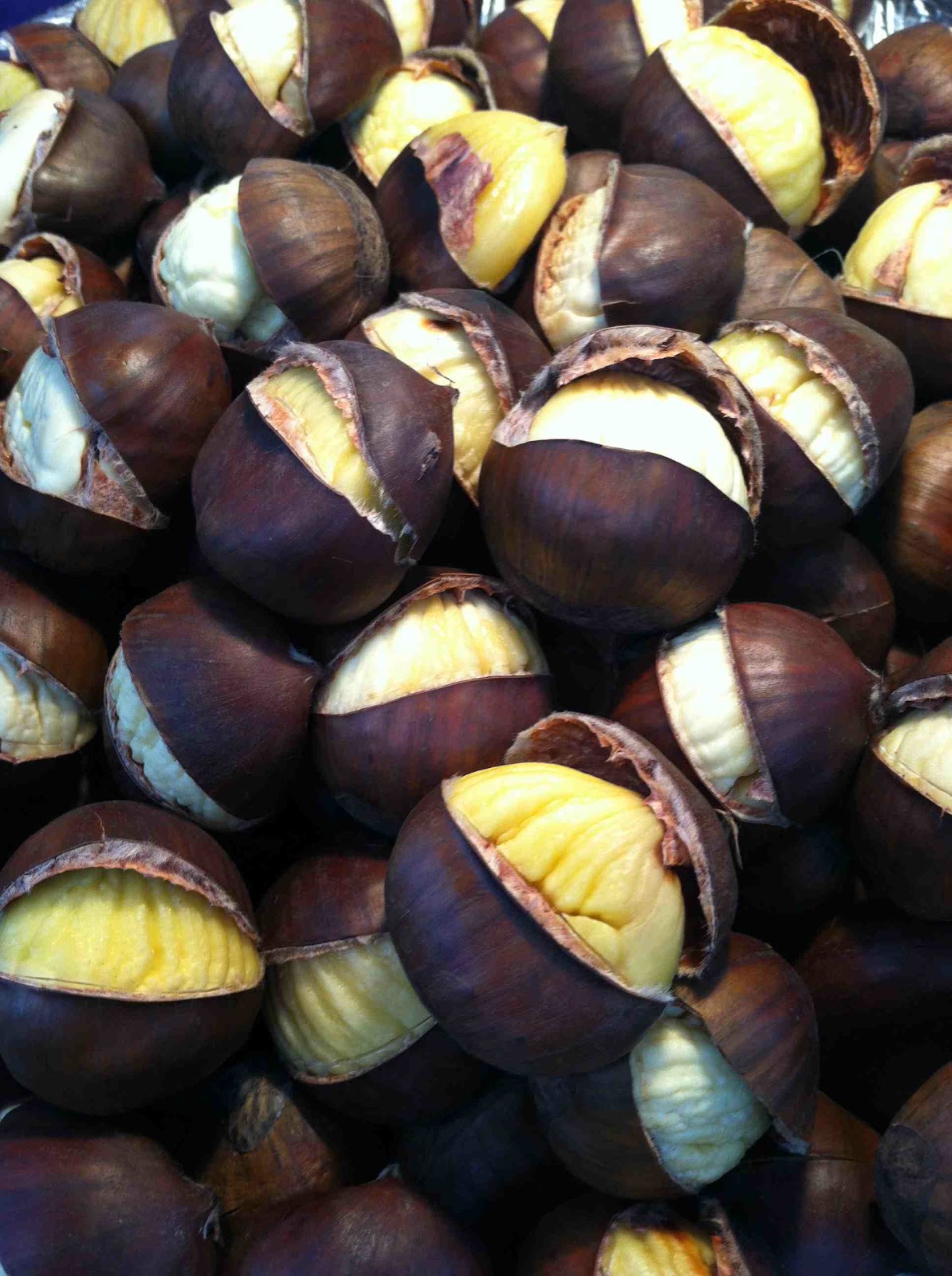
Vendors slit the chestnuts’ outer skins, then roast them till the yellow nutmeats peek out like grinning gnomes. Five dollars buys you a scoop in a paper sack. It’s worth postponing your snack to carry the bundle around in your pocket for five minutes, enjoying the warm orbs tumbling around beneath the paper.


The nutshells are smooth and woody, and as satisfying to peel as mahogany veneer from an old end table; the shell slips off with a papery crackle. You can take the whole nut out, or bite into it while it’s still half in its shell pocket. The meat is dense, sweet, slightly rubbery, and drier and more grainy than most nuts; it lacks the oil of a cashew or peanut. Laid bare in the palm, the nut is fleshy, wrinkled, and vulnerable looking, its interstitial crevasses creating a pleasing pop with each bite.


Be warned: a few roasted chestnuts go a long way. Carry your treat with you as you as a talisman while you imbibe the rest of Midtown’s sensory delights: the tolls of Salvation Army Santas’ bells, the white beard of smoke issuing from a manhole smokestack, the unexpected swishing of ski jackets as we jostle our way through holiday throngs.
Monday, November 5, 2012

TOUCH: Roosevelt Island Tramway

Despite the views and the novelty of an airborne form of public transportation, the thrill of a ride on the Roosevelt Island Tramway really comes down to a single moment: when the tram is suspended over the East River, just before plunging into its port on Roosevelt Island.

As the tram begins its journey from the Manhattan side, there’s the same clutch of inevitability experienced at the start of a roller-coaster ride: you are putting your life in the hands of a metal box on wheels and a narrow track, in this case hardly more than two metal strings looped across the river. But all is smooth, rumbling efficiency as you are scooped up out of the terminal and begin to climb over the rooftops. You feel weightless as the East Side shoreline slips away, a sensation rare among the canyons of skyscrapers you’ve left behind.

Ahead lies Roosevelt Island: apartment buildings crammed together like too many teeth in a mouth, an unfamiliar breed of buses, narrow streets, outdated shops and restaurants, patches of grass, the rusted blisters of the tennis-court domes, the sinister hulk of the hospital at the southern end. It’s cozy inside; tourists jostle good-naturedly for window space, and even the locals don’t seem to be jaded by the view.

But as the island looms, you realize the tram is going to have to land, and there’s not much space in which to do so. You look around you: what will become of the baby fussing in the stroller, the girl with a tennis racquet poking out of her backpack? To the right are the pink towers of the Queensboro Bridge; to the left is sky. Below is gray green water and white wakes of boats, a slumbering barge or two, some birds, some buoys.
 
The cables mutter; the terminal is at once so close and so far below. The brakes clamp and tremble, there’s a rumbling above, the whole car vibrates as the tram grips the wires and inches down them, like a child on the bunny slope. You can see the great spools of cables winding and unwinding in the terminal below; the whole operation suddenly seems too rudimentary. In that instant you feel a thrilling buoyancy—and a deep distrust. How can this little red box slip down the cables without crashing? Then the tram bumps and grinds over the top of the support tower and begins its terrifyingly steep final descent.
 
But the tram slows, and somehow, at the end of it all, practically tiptoes into the dock. The doors swish open; your pulse slows. Above the turnstiles is the mechanism responsible for this feat of engineering and vertigo: coppery cable threading through a hole in a Plexiglas window that looks like it was hacked out with an X-acto knife. The power and force rumbling back and forth through that little manmade hole humbles you, like touching a rivet in the side of a skyscraper.
 

Wednesday, October 3, 2012

TOUCH: Waterless shampoo at Mian Tian Sing

Girls on a budget have long known about “blow-out row” on Pell Street in Chinatown, where you can get your tresses professionally blow-dried for half the prices charged by uptown salons, no appointment necessary. These places are no frills and no nonsense: the staff speaks little English; the products are generic; no complimentary backrub or cup of tea will be proffered. But just a few blocks north, on Canal Street, and up a narrow flight of stairs is a Chinese-run hair salon, Mian Tian Sing, which provides the same services with one intriguing difference: the stylists shampoo your hair while you are seated in a salon chair before a mirror, fifteen feet away from any sink or water source.


The stylist tucks a towel into your collar, then administers a brisk neck-and-shoulders massage. She slips a plastic sheet over the towel, much smaller than one might expect, and suddenly you feel a cool squirt of shampoo dribbling down your scalp, right over your dry hair. This is perhaps the best part, akin to plunging hot feet into an ice-water bath: it feels both wrong and more tantalizing than it should.


It would seem the women who work here have retractable claws that spring from their fingertips: their long, hard strokes rake your hair, and there doesn’t seem to be a fleshy part to them as they plow furrows into your hair, pushing the hair back and forth rhythmically, both hands in sync, scrubbing around the ears, tilling the neck, pressing the temples. During one visit, “Who Let the Dogs Out?” happened to be playing in the background, and the shampooer synchronized her kneading to the music. Your head rocks back and forth like on a fast-moving subway. The stylist’s hands whip, press, scratch, delve, swoop. The shampoo and hair rise to a creamy bouffant, and not one dribble runs down the neck. It’s a miracle.


Fifteen minutes later, your head tingling, she leads you to an alcove of sinks. Water! At last! Somehow it seems a shame to deflate this foamy creation. Instead of the conventional chair, these sinks feature horizontal beds, and the neck cradle does not feel like draping your head over the edge of a toilet, as it does in so many other places.


For the record, you can also get your face professionally washed for $5 following your rinse-out. This is a sensory experience in its own right, but suffice it to say your shampooer's claws transmogrify into fluttering butterflies, flapping up and down your cheeks and tickling your jaw, and the wash ends in a startling curtain of water over your face. 


At the end of the rinse, the stylist whacks your scalp a few times with the head of the retractable faucet and plunges a dry washcloth into both ears simultaneously to remove any lingering lather. Like the hair squirt, this feels wrong, and better than it should.

The blow-dry is conventional enough, though it is performed not by the shampooer but by one of a coterie of well-coiffed young men, some of whom wield two blow-dryers threaded between the fingers of one hand, blasting your hair as if with a double-barreled gun. With the press of a flat iron, your hair sizzles and steam rises above your head. You emerge forty-five minutes later with gleaming, flounced hair, better equipped than the uptown girls for any surprises the night may offer.


Tuesday, September 4, 2012

SMELL: Corner of Water and Pine streets at lunch hour

If names evoked smells, one might expect the junction of Water and Pine streets in the Financial District to be a fragrant one: a clear stream babbling beneath resinous evergreens. Though there are no pines, there is water: a pocket park across the street featuring a man-made waterfall, and Café Water, a corner deli unremarkable in all but one respect: the fetid gust of steam-table food smell wafting out of its garage-door-size kitchen vent.


At 10:45 one Friday morning, just past egg-on-a-roll hour but before cheese-steak time, the scent was of soy sauce with undercurrents of vinegar. Inside, workers were stocking a steam table running the length of the room and crowned with turrets of plastic clamshells.


The vent’s emissions were confirmed: at $7.79/lb, glossy orbs of chicken studded with sesame seeds, slayed asparagus spears festooned with a stripe of chopped pickled peppers, squirming heaps of lo-mein. 


Saran Wrap rolled back over each tray gave the impression that the food was napping under a sheer blanket.


The back wall of the deli offered a vista of soft drinks behind rubber flaps. The bathroom was the kind of place where you flush with your foot and open the door with a scrap of paper towel. Café Water received a C on its most recent inspection by the Department of Health. I noticed a clip-art sign posted to the steam table. It featured a yellow armless hand (a glove?) fondling two chicken drumsticks: PLEASE DO NOT SAMPLE FOOD. 


A family of jet-lagged tourists slouched at a table overlooking the Pine Street alley, nursing a bottle of strawberry Nesquik. A few businessmen twiddled with their smartphones in front of the panini bar, where stacks of wan sandwiches awaited pressing.

Outside, I made a pass by the vent again. Fried chicken. It was approaching 11 a.m., when the early lunchers would begin to trickle in. Moving away from the vent, I realized the odor trailed me all the way across Water Street, where the waterfall beckoned. The chlorinated smell—almost as astringent as pine—soon obliterated the greasy musk. The splashing water tickled my toes.