A monthly blog about the sensory experience of New York City

Thursday, May 20, 2021

SOUND: Pigeon auction

On Sundays at 10 a.m., this alleyway in West Babylon, New York, fills with the sounds of cooing and clucking, wings beating against chicken wire, and the guffaws and grumblings of a group of longtime friends and foes.

Across the street, alongside the chain-link fence abutting Wellwood Jewish Cemetery, doors of pickup trucks bang shut as men carrying slatted wooden boxes stride toward the alley. On their car windows, alongside Mets bumper stickers, you might spot a subtle pigeon decal. A few stray feathers drift across the asphalt. 

If you are a pigeon fancier—also known a mumblers or a flier—from the New York metro area, the auction at E. F. Pigeon is the place to be on a Sunday morning. As the bidding gets organized inside a warehouse space off the alley, the fliers gather around an outdoor coop in the parking lot for coffee and a smoke. There are shoulder claps, gibes, and side-eyes as friends and competitors arrive. The pigeons mill about in their cages, murmuring and churring like the men.

Inside, the smooth, rolling calls of auctioneer George Ruotolo begin to echo off the metal ceiling and carry out to the lot: "Ten bucks apiece, ten dollars once, ten dollars twice!" Ruotolo, who is a hair stylist in his other incarnation, sports a smooth comb-back and a camo shirt, and has a thick Long Island accent. He perches on a crate above a stack of cages filled with birds. 


About twenty men and a couple of women—almost all middle-aged and of varied racial backgrounds—are gathered before him, eyes fixed on the birds in his hands. 

Almost everyone is wearing a mask, but there's no social distancing going on here: you have to get close to see the birds, which come in myriad colors and lustrous plumages. These are not street pigeons: they are immaculately groomed and cared for. Most of the fliers know one another and their pigeon proclivities, but if you're a newcomer, the first question is "What's your breed?"


The warehouse is outfitted with stacks of pigeon feed bags and an assortment of office chairs, where the fliers perch to trade notes and gossip. At the front, a woman sells coffee and alfajores cookies next to a display of miniature roosters, also for sale, whose insistent cockadoodledoos occasionally drown out the auctioneer.


Ruotolo reaches into a cage and extracts a bird, cupping its body and gently pinning down its wings as he raises it above his head, rotating it to display its features. The pigeon seems unphased. "Talk to me, guys, talk to me. No bids? Okay, he's going down." The pigeon is placed a cage on the floor and the next bird is extracted. The going rate is about ten dollars per bird, though sometimes they are sold in pairs or even trios. "Nice young homer here, fellas, check it out," he calls. Many of the buyers are pigeon racers, who keep coops in their yards or on their rooftops and breed the homing pigeons they buy here, training them to fly increasingly long distances. One breeder tells me a popular release spot is a parking lot by the foot of the Verrazano Bridge: fliers drive there, let their birds free, start their timers, and race home to clock their arrival.

"Sold!" he shouts. "Here ya go, pal." Cash and birds are exchanged across the tops of the cages. The birds appear calm and alert in their new owners' hands. 

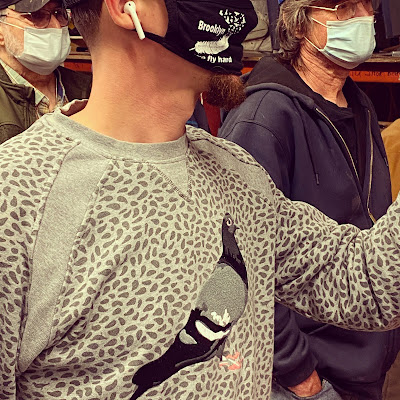
One guy, who is documenting each sale on his phone, wears a pigeon-themed sweatshirt and a mask printed with "Brooklyn We Fly Hard."
Over a stack of pigeon feed, two white-haired men in windbreakers gossip about a retirement community a friend has moved two. "Lotsa swingers down there, I hear. That's where I wanna go. I wanna get outta my house and swing!" But their attention is diverted by a trio of white birds that's creating a flurry of bids. "Fifty-five! Sixty-five! Ho!" The crowd yells: "Shit!" The auctioneer calls: "Eighty! Let's hear it!" "Ow!" the crowd responds. In their cages and boxes, the birds flutter, picking up on the excitement. The three birds sell for eighty-five dollars. Someone jeers, "He just got his retirement check!" 

Behind the auction block is a separate room where the pigeons are bred. Pigeons mate for life, and each couple has its own cage, the male and female taking turns sitting on the eggs, which are nested in terra-cotta dishes.


The room smells like hay and seeds with an acidic undercurrent of pigeon guano. The pigeons cheep and cluck and preen and purr, filling the warm space with an attentive parental energy. The pigeons seem to be trading notes through the cage bars just like the fliers on the other side of the wall.

Though baby pigeons are a perpetual urban mystery, they're easy to find here, soon to be held aloft above a crowd and, after that, to swoop over Long Island lawns and Brooklyn rooftops.

Besides the lack of women in the crowd, there's a dearth of young people interested in pigeon racing. One man remarks: "The kids these days, they're all—" He bows his head and taps his thumbs on an imaginary smartphone. So the group is particularly excited by the arrival of a young pigeon enthusiast and his stuffed-animal pigeon. He is peppered with questions and advice: "What's your favorite breed?" "Where do you live—you say you got a rooftop?" "So you wanna race 'em?" "Gotta start the flock small, build from there." The stuffed pigeon soon finds itself hoisted above the crowd: "A hundred fifty for this pigeon!" Out in the lot, one man says to another: "You see everything at this auction."




Thursday, April 15, 2021

MULTISENSORY: Ramblersville, Queens: New York's smallest neighborhood


Welcome to Broadway, in Queens, New York. 


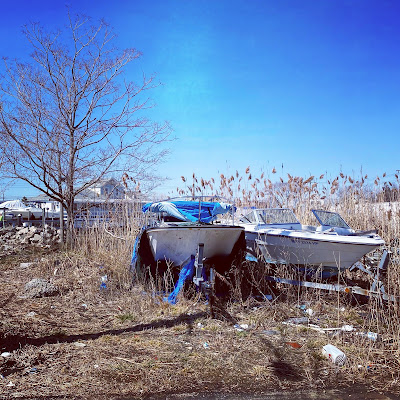
Though each of the five boroughs has a Broadway, this one, in the tiny nautical hamlet of Ramblersville, is about as far as one can imagine from the spinning lights and hot dog steam of Times Square. At the intersection of Broadway and Church Street, boats are parked alongside pickup trucks, and the air smells like tar paper, damp wood, and seaweed.


Ramblersville, also known as Hamilton Beach, is arguably the smallest neighborhood in New York City. It comprises three spits of land, wedged between Howard Beach and JFK International Airport, that reach into a hooked strip of water known as Hawtree Basin, which joins Bergen Basin and Shellbank Basin to flow out into Jamaica Bay. 

Water is a way of life here. All Ramblersville streets dead-end in Hawtree Basin, and bridges crisscross the canals. On a weekend afternoon in early spring, the air fills with sounds that could be from another era: the cawing of seagulls; the hollow hammering of a men patching a wooden dock; dogs barking at front doors, leaving nose streaks on the storm glass; and mothers calling to their kids, who zizz past on on bikes, weaving between the cul-de-sacs.

Many of the houses are raised on pilings over the water, and ducks, swans, and geese drift just a few feet below living room floors.

Ramblersville is a neighborhood of rainbow whirligigs and patriotic flags, of Easter and Saint Patrick's Day decorations and mailboxes shaped like churches, barns, lighthouses, or sometimes all three. 


Though planes from JFK rumble close over rooftops and the A train rattles past just yards from the doorsteps (the gleaming Howard Beach AirTrain station is a short walk away across a marsh), this neighborhood feels out of step with urban life. One street, Bayview Avenue, is a wooden boardwalk flanked by picket fences. 

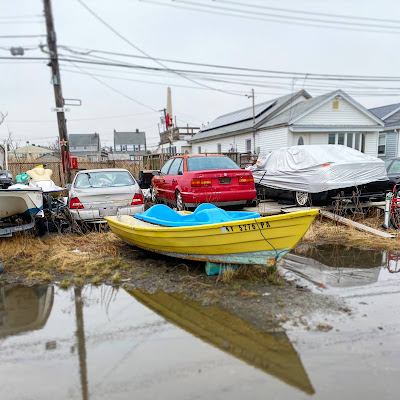
Boats are ubiquitous: parked on trailers in driveways, bumping against docks, belly up by the sides of roads, and stashed in vacant lots surrounded by beach grass.


If the chickens in this yard were to take flight, 


they'd see the sparkling waters of Jamaica Bay connecting this sleepy neighborhood to the world.


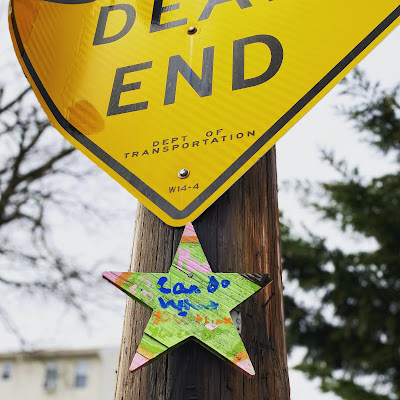
Beneath each of the Dead End signs along 104th Street—which is as close to a Main Street as Ramblersville has, despite its Broadway—some local children have tacked wooden stars painted with inspirational messages. Most have faded in the sea breeze, but one message is still visible: "You can do whatever you think you can." This seems an apt reminder that there is always more to explore in New York, even when you think you've come to its end.


Monday, February 22, 2021

TASTE: Biscuit tortoni, a classic New York confection

I admit that I find it hard to resist any food served in a paper cup. Having tasted the Charlotte Russe, a cake-and-cream dessert that pops up from a polka-dotted paper sleeve, I thought I'd tried all the iconic New York City foods presented this way. I was delighted, therefore, to learn about the biscuit tortoni, a concoction of frozen almond-flavored custard mixed with crushed amaretti biscuits, topped with crumbled almonds and a frozen maraschino cherry, and served in a pleated wax paper soufflé cup.

According to Arthur Schwartz's book New York City Food: An Opinionated History and More Than 100 Recipes, the biscuit tortoni originated in eighteenth-century Paris, where a certain Neapolitan named Signor Tortoni opened an ice cream café where the dessert was first served. From Café Tortoni it made its way a century later to New York City; no one quite knows how. Schwartz claims that biscuit tortoni is unheard-of in Naples today. In New York, as Amanda Hesser mentions in a New York Times tribute to the confection, it became a staple in Italian American restaurants, from the Waldorf-Astoria to casual red-sauce joints and to street carts. Édouard Manet memorialized Café Tortoni in a painting, though the dour subject seems to be fueling his writing with a beer rather than a tortoni.

Chez Tortoni by Édouard Manet. Reproduced from Wikimedia Commons

These days, there are few places this classic New York City dessert can be found. One is restaurant in the West Village, Villa Mosconi, which has an entire webpage devoted to the dessert but is, unfortunately, closed at the moment. Plus, I decided I wanted to eat my tortoni like a nineteenth-century child might have: on the street, with traffic rushing by. So on a recent snowy day I headed to Villabate Alba, a Sicilian bakery on Eighteenth Avenue in Bensonhurst, Brooklyn, which beckons visitors with a human-size cone of gelato.


Stepping inside Villabate Alba is like stepping into a wedding cake. The ceiling features a fresco of clouds and angels, statuary of the Holy Family and Rangers memorabilia decorate the tops of the displays, and marzipan fruit, rainbow cookies, and cakes dripping with decorations gleam beneath the glass. 


A mute maître d' wearing a baseball cap labeled "Pristine" directs visitors with glares and hand gestures and straightens the carpets and retractable stanchions. An Italian radio station plinks from the speakers, and everyone orders in Italian. This place is the real deal.


I pinch the paper cup—known in Italian as a coviglie—between my fingers and carve my spoon through the topping of crumbled amaretti cookies into the frozen custard. It's slightly gummy and chewy and not too sweet. The cream has a foamy quality despite its thickness: it tastses more like a frozen whipped mousse than ice cream. The almond flavor and crunch of the topping add bite to the creaminess. One of my favorite features of frozen desserts served in paper cups is that they melt from the outside in, responding to the heat of your fingers, and the cup softens and squishes and almost becomes part of your hand. 


The frozen maraschino cherry provided a burst of crystallized saccharine delight, the flesh of the fruit glimmering in crystals against the teeth, its artificial sweetness a nice counterpart to the mellow custard. Alternating bites of icy sweet cherry and soft, almond-scented, biscuit-studded cream proved the best way of enjoying this dessert.


As I drove home through the Brooklyn streetscape of gray buildings and grayer snow, I happened upon this block of West Ninth Street, where a stretch of tidy houses offered a burst of color and fanciful decorations—stripes, rooftop spires and filigree, pink and yellow and golden paint. It was not unlike Villabate Alba and its biscuit tortoni, whose cold, bright flavor lingered on my tongue through the rest of the dreary day.


Wednesday, January 27, 2021

SOUND: The Iron Triangle in Willets Point


As I exit the expressway toward Willets Point Boulevard, men flag me down at the stoplight. "Hola, Mami! You need car repair? This way!" To my right, the billboards of Citi Field pierce the sky.


But the men are waving me to the left, where a man hunkers under a beach umbrella, fanning a trash-can fire. A structure of corrugated metal and stacked shipping containers, topped with piles of tires and broken windshields, teeters behind him like an absurd automotive wedding cake. With a flattened cardboard box, he swats at passersby, who raise their hands in greeting.


Welcome to the Iron Triangle, a roughly six-block shantytown of more than two hundred auto-repair businesses, chop shops, and salvage yards operating out of Quonset huts, hovels, and even RVs, that has existed in Willets Point in some form since the 1930s.


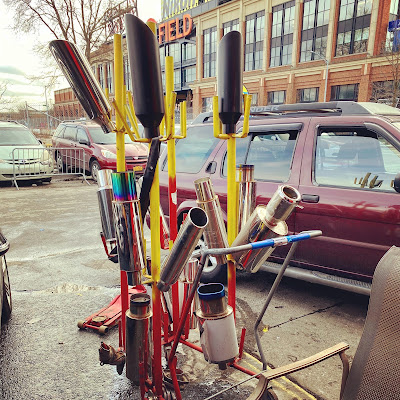
Their shop names exude promise: Sunrise, Good Luck, Happy, Rich, New Beginning. The 250-odd businesses here make up the most concentrated, efficient, and competitive auto-repair zone in New York City. Here you can get your flat fixed, muffler welded, hubcaps replaced, dented door banged out, upholstery patched, or upgrade your exhaust tip—fast and for cheap—in the hands of the Iron Triangle's roughly 1,500 skilled workers, who these days are mostly low- and middle-income and Hispanic.


In this urban underbelly, there seem to be lots of unwritten rules. No to honking. Yes to haggling. It's mostly a men's world, though I saw some women and even children epoxying cars and selling coffee. Vehicles queue up, chatting through open windows as they wait for quotes. They are families in minivans who need a transmission, livery car drivers in search of a side mirror, a guy in a Porsche looking for a window tint. People come from across the tri-state area knowing they'll get a good deal. So the shops compete, and even in these blighted surroundings, presentation is an art. From rim racks,


to tailpipe trees,


to tessellated tire stacks.


But if you're one of the few visitors exploring on foot, the Iron Triangle offers a rare synergistic symphony. Sawzalls zizz as they slice into tailpipes.


Buffers whir; sparks sizzle.


Everywhere, clanging and tapping and banging reverberate off metal walls. Socket wrenches stutter. Hydraulic lifts hiss.


Shopping carts rattle over the rutted streets, pushed by men collecting scrap metal to sell—or peddling tube socks, like this man.


The Iron Triangle is located on a flood plain at the confluence of Flushing Creek and Flushing Bay. Seagulls caw above the marsh grasses. Every few minutes the rumble of a low-flying plane from La Guardia pierces the clouds.


The roads here are unpaved and exempt from street-cleaning rules. Cars drive slowly, careful not to splash the workers as tires slosh and slap through the mud, popping the mini liquor bottles and plastic clamshells that clog the puddles. There are no traffic signs, sidewalks, or stoplights. Loitering men direct cars in a coded language of hand signals, whistles, and "Heeey-ep!"s.


The 7 train squeals past on the elevated tracks. Every so often, amid the cacophony of metal, you hear the mewl of an alley cat. They slink out of minuscule doorways, rubbing their backs against the corrugated tin. 


Salsa and merengue plink from the open windows of idling cars and the trunks of minivans serving as makeshift cafés. 


There are no bathrooms, since the area is cut off from the city sewer system.


For over a decade, starting under Mayor Bloomberg, much-contested and renegotiated plans have been in the works to redevelop the Iron Triangle. At various points, they have included a mall, a hotel, parking lots, a school, affordable housing, and parks. In the process, under the threat of eminent domain, many businesses have already been razed, evicted, or relocated, and streets have been closed. Remaining businesses have lost customers. A final plan was approved by the De Blasio administration in 2018—but then came the pandemic. For the moment, the fate of the Iron Triangle hangs in abeyance.


In the meantime, the community is making the best of what they've got. This is a place where everyone has a role, from the scrap-metal dealer to the empanada vendor to the flat fixer. And those roles are interdependent: if the businesses are relocated, the Iron Triangle loses its cohesive strength. 


But in this limbo year, people still turn left off the exit ramp, away from Citi Field's Porsche Grille gastropub and toward the stacks of Porsche grilles, hoping one will be a match. Though the stadium is silent, here the sounds of cameraderie, and of people making a living with their hands, ring out in the winter air.


The Iron Triangle is located on the wedge of land where Flushing Creek and Flushing Bay meet, between Willets Point Boulevard, Seaver Way, and Northern Boulevard.