A monthly blog about the sensory experience of New York City

Friday, January 10, 2020

MULTISENSORY: Luxury Escapism: a virtual reality spa

It's true that at Luxury Escapism, a new multisensory spa in DUMBO, you'll find waffle-weave robes, dim lights, and a decanter of cucumber water.


But in place of lavender eye masks, you'll find electronic goggles called "eye massagers." In place of massage tables draped with towels, you'll find vibrating beds with gravity blankets. In place of almonds, you'll find Hi-Chew "intensely chewy candy." In place of new age music, you'll find a "sonic sauna." And in place of flickering candles, you'll find strobe lights and virtual reality goggles that transport you into geometric projections of infinity.


"I feel like I'm in a cross between West Elm and the Sharper Image," my companion whispered as we padded around the basement space in our courtesy slippers and robes. The pink light notwithstanding, the room—divided into eleven experiential zones—had that familiar millennial immersive-experience vibe: all tactile surfaces and activity stations and, arrayed on every surface, VR goggles. Here was self-care with a thrumming bass line of tech. It goes without saying that the entrance to Luxury Escapism is through an unmarked basement door.


However, even though the spa advertises its Instagram handle on its postcards, the posing-and-posting impulse is held in check by two ground rules: no phones and no talking above a whisper. (I got a press pass.) Instead, the spa promises to connect you with the present moment through "technology that actually feels good." If you're expecting a facial and a hot-stone massage, you've come to the wrong place—though there are faux hot stones set around an electric campfire.


On the night I visited, the ten or so other spa-goers were mostly young couples who seemed thrilled by a novel New York City date night. And while it is true that (as far as I know) there is no other place in New York City quite like this, our expectation of novelty—foundational to the immersive and pop-up experiences that abound these days—is becoming increasingly familiar.


Goggles of many sorts abound at Luxury Escapism. I decided to begin in the Yogibo Lounge, where I picked up my first pair: an electronic eye-massaging mask. It felt sort of like a blood pressure cuff inflating and deflating over my eyeballs while emitting wheezy puffs. A set of VR goggles catapulted me into a 3-D jungle; thankfully, the comfortable Yogibo beanbag kept me grounded. Soon an attendant beckoned me to "Rainbow Therapy," one of the spa's two timed experiences.


I lay down on a water bed and closed my eyes. The room darkened and the bed began to convulse. Strobe lights pulsed through my eyelids. Though I could control the intensity and vibrations, I felt a panic attack coming on. To stay sane, I silently chanted the mantra, "I am healthy and fit. Probably I will not have a stroke."


Next, I ducked into what would be my favorite experience, the Kinetic Sand Dome, a yurt with kinetic (moldable) sand, scoops, and slicers. The tactile experience was heightened by—goggles! But these were a non-VR pair with a lens that somehow separated my hands from my body. As my friend put it, "I feel like I'm watching an instructional video of myself in real time."


The next stop was called Lux TV: a couch in front of a TV showing grainy footage of ASMR installations, and a table of fidgets to calm your hands.


As my friend and I were playing in the Sound Stones playpen—a gravel-floored space outfitted with simple, childlike musical instruments and a headset you could use to manipulate the sounds—we were called into the Sonic Spa, the second timed experience. After the door closed on the small, windowless room, we plunged into total darkness alongside several strangers: panic attack #2. But then the soundscape began—a melange of birdsong, sticks breaking, snow crunching, cicadas. The darkness ended up being a welcome break from the audiovisual input.


VR goggles had greeted me at nearly every turn, from the Fuzzidarium, a room swathed in white fur; to a pair of hammock chairs; to the vibrating beds of the Senscape, where I took a float down a virtual stream; to the Cosmic Steam Room, where, using hand gestures paired with goggles, you could manipulate images projected on a scrim.


As the two hours were nearly up, I decided to cleanse my sensory palate with a Hi-Chew, one of those candies that is simultaneously stressful (it's claustrophobic! it fills the mouth entirely and sticks the teeth together! it seems it will never be swallowed!) and satisfying (the burst of fruit flavor! the teeth-sinking texture! the intensity!). For the forty-five seconds it takes to consume one, you can think of little else: it forces you into the present moment.


So it was for me at Luxury Escapism. Then I swallowed a paper cup of cucumber-infused water and the candy was gone.

Monday, December 16, 2019

SIGHT: Secret Christmas tree memorial for departed pets

It could take hours to find—or minutes, if you happen upon the right sequence of paths in the labyrinthine Ramble of Central Park


At first it's just a flutter in the corner of your eye, a pattern to the light. Then it emerges from behind a tangle of bare branches: an ordinary evergreen tree, not too different from the two trees flanking it, except that on Sunday in mid-December, it seems to be receiving an unusual number of visitors.


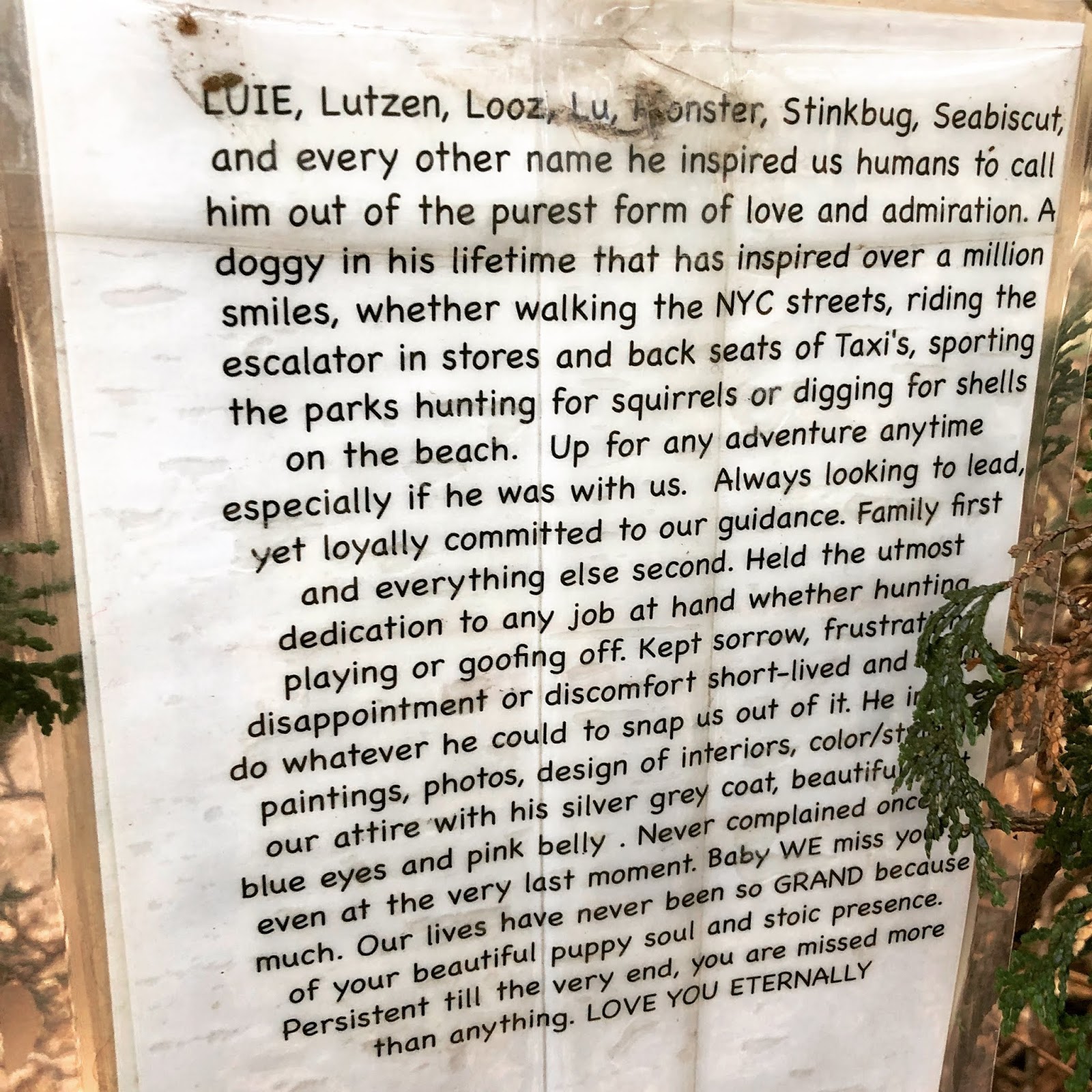
Get closer still, and you'll see why. The tree is bedecked in dozens of Christmas ornaments. Upon closer inspection, you'll notice that most of the ornaments are homemade and are dedicated to pets who have died. Photos of each animal have been laminated and strung with ribbon or encased in Ziploc bags to protect them from the weather.


There are dog treats for good behavior in heaven,


a beribboned collar as a reminder of favorite city walks,


or a bit of honey for the afterlife.


There are curious talismans, including one made of hair, glitter, and ribbon—with a checkered taxicab theme.


There are no backyard chickens or urban sheep. Ming the tiger, who was raised in an apartment in a Harlem housing project and died this autumn, has not yet been commemorated. Most of the pets are cats or dogs, but there are a few outliers: a bunny named Winnie,


a box turtle named Sherman,


and a budgie named Buddha.


Some of the ornaments are simply a photo and a Sharpied name. But others have odes to the lives of pets in the heart of a big city.


I had brought with me an ornament—laminated for free by a sympathetic Print Services worker at Staples—memorializing our family's two goldfish, Ralph and Frank. They turned out to be the only fish on the tree.


As I walked away, I heard the plastic ornaments rattling against one another in the breeze. In this secluded grove in one of the few wild places left in Manhattan, these homemade offerings provide an intimate glimpse into the lives, apartments, and hearts of New Yorkers and of the creatures who offer them unconditional love and predictability in an unpredictable city.


The location of the pet memorial tree is kept a secret by its keepers, but if you are lucky you may stumble upon it during a stroll through the Ramble.


Wednesday, November 13, 2019

SOUND: ASMR sound bath in a Bushwich church basement


I first discovered ASMR one evening as I was standing in my then boyfriend's kitchen, idly rolling a grapefruit across his marble countertop. It made a thuddy, rubbery swishing sound. "Do you hear that?" I asked. He listened, then replied judiciously (wistfully?): "Hm. I just don't hear it the way you do." Though we eventually got married, we still don't always hear things the same way.


It turns out there are others who appreciate life's small, satisfying sounds. What I experienced is called an autonomous sensory meridian response (ASMR): the relaxing, sometimes scalp-tingling feeling some people have in response to a series of repeated sensations, usually auditory, tactile, or visual, such as the crinkling of a wrapped Band-Aid, a makeup brush against one's cheek, or a knife slicing through a just-decanted cylinder of cranberry jelly. Though arguably ASMR has existed for millennia (a crackling wood fire is a common trigger), about ten years ago it became an internet phenomenon. And on a recent night, it was what led me to a Bushwick church basement to attend Waves, an ASMR-stimulating sound bath.


After descending stairs beneath a neon sine wave and whispering a password through a peephole, I entered a basement room outfitted with a desk, a lamp, and a seashell.


Each participant was given a pair of latex gloves and a handful of glass beads. Another door opened, and we were led into a vintage gymnasium. Yoga mats with pillows were arrayed like wheel spokes around a hub of instruments. An electronic drone bounced off the shadowy basketball hoops and chiaroscuro walls. The lights dimmed to near black.


Two figures in conical hats draped with fabric strips shuffled into the room, the cottony flapping of their robes providing the first taste of ASMR. I heard a faint crackling and soon smelled the waftings of campfire smoke as the figures circled the room with sticks of palo santo incense. The tinkling of tiny, fingery bells encircled us in lacy acoustics and cleansed the air.


"
I wanted to offer New York City a mysterious and theatrical sound bath with music and costumes," Andrew Hoepfner, one of the robed figures, later told me. Hoepfner is the creator of Waves and co-creator of the live ASMR experience known as Whisperlodge. He told me that Waves was inspired by sound baths he'd attended that incorporated "the full smorgasbord of trappings," from disco balls to animal statuary. With Waves, he wanted instead to "shine the spotlight on little details we all like, whether or not you get tingles." Both he and his assistant--tonight a man named Will--
remain incognito throughout the experience.


With my eyes closed and reclined on my mat, I heard the hollow glugs of water being sloshed around in glass jars with tin lids. Andrew poured the water back and forth between jars, producing a simultaneous rise and descent in pitch as one jar filled and the other emptied.


They next ran their fingers along the teeth of two plastic combs, sometimes tantalizingly slowly, releasing each tine before clicking onto the next, and sometimes fast, creating a tinkling, zippery ripping, holding the combs next to each participant's ear. I couldn't help smiling, though I didn't quite get the tingles. Punctuating the ASMR noises was the plangent, elephantine squeeze of a harmonium.


Andrew ran a stick over the back of a wooden frog with a ridged spine, creating a nutty, knuckly sound.


A Tibetan singing bowl keened and hummed, like a finger run over the rim of a wineglass.


Andrew then asked us to slip on our latex gloves and rub our fingers together to "make noise for the room," then to bring our fingertips next to our ears and "softly, secretly, make some sounds just for you." The powdery whisper felt intimate and alive, like the static between tracks on an LP. When we cupped the glass beads in our gloved hands, they washed against one another with watery clicks. Then Andrew and Will swept around the room, crumpling sheets of tissue paper with a crashing roar, then bending rolls of thicker paper back and forth, which sounded like a flag whipping in the wind. Held next to my ear, the tissue had the effervescence of lather foaming on one's ears during a shampoo. Then came the springy pings of a thumb piano.


After a wafting of sage incense, Andrew played the ocean drum, which is filled with metal beads that sweep against stretched fabric like wind blowing sheets of rain across an expanse of water. Andrew flashed about the room, casting his shadow across the pressed-tin ceiling.


I realized that noises that might otherwise have annoyed me had now become part of the ASMR landscape: the rustling of a parka, joints cracking, a zipper, snoring (!), and even the meteoric growling of a rumbling stomach. My most recent Waves sound bath happened to take place on Election Day; Andrew had forgotten that the church is used as a polling site. On that night, the sounds of the show were punctuated by heavy footsteps and the scraping of table legs in the room above us. It occurred to me that this might be a litmus test for ASMR: from the pings of a hair comb to democracy in action.

For tickets to the next Waves sound bath at Gymnopedie, Hoepfner's arts and performance space in Bushwick, click here. The photos above were taken after the sound bath; no photography is permitted during the experience.

Thursday, October 10, 2019

MULTISENSORY: Urban forest bathing


The buildings of Central Park West rose beyond the treetops as Brooke Mellen, the owner of Cultured Forest, a local forest bathing and nature therapy group, instructed us to face each of the four cardinal directions. "Which one feels best?" she asked. This was the opening of what would be a two-hour session of shinrin-yoku, or forest bathing, in a setting far removed from the practice's roots in 1980s Japan. To me, the most comfortable direction was west, toward the city, with the sunlight on my left arm.


I admit that when I first heard the term "forest bathing," I pictured myself splayed on the forest floor, gazing up at the treetops, or perhaps sprawled facedown, nuzzling into a bed of moss and pine needles.


So I was surprised to find that, at least in the United States, forest bathing includes few moments of rest. As described by the US-based Association of Nature and Forest Therapy, here shinrin-yoku is "a practice of developing a deepening relationship of reciprocity, in which the forest and the practitioner find a way to work together that supports the wholeness and wellness of each. In forest therapy, there is a clearly defined sequence of guided events that provides structure to the experience, while embracing the many opportunities for creativity and serendipity offered by the forest and the individual inspiration of each guide." 


As we concluded our opening ceremony, peals of laughter and waftings of palo santo incense drifted toward us from a nearby group of French picnickers. Rather than feeling annoyed, I smiled at the thought of this group engaging in their own form of forest therapy, albeit with wine and cheese. 


Next, we stopped at the junction of two paths. Brooke had us reach into a bag of stones and select one to infuse with good intentions for the person across from us. Mine was prickly and glinted with mica. We squeezed our rocks and tried to exchange them without opening our eyes. My partner and I crashed into each other, but succeded in passing off our stones. Hers was still warm from her hand.


We strolled on to our next location, observing the movements in the park around us. A dog leaped to catch a squeaky ball. Chipmunks rustled in the underbrush. Bees hovered over flowers. A topless man did calisthenics on a picnic blanket. As usual in the city, everyone was doing their own thing, but on this fall day their disparate activities seemed to be in sync.


Brooke led us to a secluded grove, where she encouraged us to spend ten minutes immersing ourselves in the forest. Aha! Forest bathing at last. I found a slab of Manhattan schist and lay on my back, inhaling the tannic scent of early autumn and letting the breeze wash across my face.


My reverie did not last long, however, as three men emerged from the trees lugging bulging trash bags. They were soon followed by a man on a bike. "What y'all doing here?" he chastised one member of our group. "I was smokin' some weed--or I was about to smoke some weed till all y'all came along!" As it turned out, he was a forest bather himself, though perhaps not by choice. The eye of his tiger-print blanket glared out at me from beneath some trees.


After a few more activities, including communing with a tree and throwing stones representing our burdens into a waterfall pool, Brooke had us create Andy Goldsworth–esque art installations in the woods. As I rooted around the forest floor, I kept coming across pieces of litterfour blue cigarillo sheaths, a Magnum condom packet, sublingual film for narcotics overdoses, a Honey Bun wrapper, nickel bags. All seemed to be tokens of the ways humans escape from themselves and their surroundings. 


Rather than reject the detritus, I decided to incorporate it into a mandala to honor the dark underbelly of the city's woodland. Brooke had told me she sometimes arrives ahead of the session to pick up litter from each of the sites, but in this case I was glad she hadn't. Even if the point of forest bathing is nature appreciation and contemplation, it seemed disingenuous to ignore the reminders of our urban setting.


Our last stop was a boardwalk overlooking a burbling stream, where Brooke unveiled a forest-themed tea ceremony from her backpack, including a thermos of dandelion tea and a box of maple leaf sandwich cookies. She passed around a balm made from hinoki cypress, native to Japan, to rub on our wrists to stimulate our sense of smell. Then she sang a heartfelt rendition of the Beatles' song "Blackbird," her voice mingling with the rushing water. An elderly birder with binoculars around his neck paused to listen, smiled, and mentioned a wood thrush he'd spotted near the stream, another urban forest bather making the woods his own.