A monthly blog about the sensory experience of New York City

Wednesday, September 11, 2019

MULTISENSORY: A two-vine winery on a Carnegie Hill brownstone rooftop


When Latif Jiji was twelve years old, he would pass by his father’s wine barrel near their kitchen in Basra, Iraq, lift the lid, and inhale. Seduced by the scent, he sometimes dipped in a finger and licked the juice from his fingertip. (His father, an amateur vintner, hadn’t yet figured out that wine should not be stored in containers with loose covers.) “That was the origin of my daring to repeat it. It’s all based on feeling, intuition,” Latif, now in his nineties, says.


Those stolen moments were the sensory spark of Chateau Latif, Manhattan’s only vineyard and winery, which evolved by accident in the backyard of his family’s Carnegie Hill brownstone. “I’m not really into fine wine tasting or anything like that,” he says. “The taste of my father’s wine is the one that has stayed with me.”


In 1977, Latif snuck a Niagara grapevine into his garden, which had previously been his wife’s domain. Then he sort of forgot about it. But seven years later, after he returned from a summer vacation, he noticed that it had grown to about fifteen feet long—and had started to produce grapes. 


Excited by the prospect of re-creating family history, he decided to harvest the fruit. The first crew, in 1983, was just Latif and one of his daughters; no wine was made that year. Soon after, he planted a sprig from the first vine to create a second. Together, the twin vines, now more than one hundred feet long, have climbed the back wall of his four-story home and sprawled across a rooftop arbor in an urban terroir of bitumen roofing, AC compressors, and water tanks, and with a view of skyscrapers.


Chateau Latif produced its first fifteen half bottles in the second harvest, in 1984. Though wine from the early years is drinkable, he didn’t know enough about proper corking those first years. He has saved these bottles for posterity in his wine cellar, a hobbit hole in the front of his basement. 


A retired engineering professor, Latif is always making improvements, but Chateau Latif’s operation is decidedly homespun. His vines are watered by urban rainfall and city water, and he prunes them only once, in winter. In 2019, he harvested four hundred pounds of grapes, which will make eighty bottles of white wine. On harvest day, around Labor Day, about thirty friends and family members—including Latif’s children and grandchildren, who all live in Manhattan—will gather and work from morning till early evening. The process starts with a climb up Latif’s defiantly steep staircase to the roof, where a hatch leads to the arbor.


In most vineyards, the vines are only five or six feet tall, so harvesters do not need to snip grapes upside down, standing on benches and milk crates, as they do at Chateau Latif. But here the crew is rewarded by a panoramic view of the Manhattan skyline.


The crew shuttles them down the back wall of the brownstone in a plastic laundry basket, using a pulley system.


In the backyard, the harvesters receive the grapes, weigh and wash them, and feed them into a manual crusher and de-stemmer. Children love to turn the crank and watch the stems move to one side of the de-stemmer and fall into a bucket.


The grapes then go into a wine press lined with netting to extract the grape juice. The first sweet squeezes of Chateau Latif wine ooze out the sides.


They pour the juice into five-gallon glass jugs and add a precise amount of metabisulfite to kill the natural yeast. A measured amount of yeast is then added and fermentation begins in a day or two. Fermentation ends after about a week, and the jars are topped off and sealed with airlocks to let gases escape but no air can enter. The jugs are stored in Latif’s ingenious wine cabinet, constructed of insulation boards and cooled by a mini-fridge with the door removed.


Using a back issue of the New Yorker and school glue, Latif attaches the signature labels. They are hand-watercolored by family and friends and feature an image of his brownstone with the roof arbor atop and legendary vine trailing down the side.


He seals the bottle neck with a plastic heat-shrink capsule over his kitchen stove burner.


“My goal is not to make the best wine but to have a story,” Latif says. Is it a stretch to say the 2018 vintage tastes of the Second Avenue subway, the pleats of private-school uniforms, glazed Dunkin Donuts, the metal chains of a playground swing set, dry cleaning, and the wax-and-wood of Brick Presbyterian Church—all in the vicinity of Chateau Latif’s vines? Perhaps, but that it tastes most of is family and history.


Wednesday, August 7, 2019

SIGHT: The weed-eating goats of Riverside Park


One recent weekday morning, a group of goat enthusiasts gathered at the intersection of Riverside Drive and 120th Street to see five of their favorite ungulates compete for the title of “Greatest Of All Time” (G.O.A.T.). A balloon-bedecked fence separated the crowd from the goats, who were up on their hind hooves trying to reach the shrubbery of Riverside Park, which was, for now, tantalizingly out of reach.


After the awards ceremony, the top four goats would be led from the podium, through a gate, and into a two-acre enclosure, where they would spend the next month munching 25 percent of their body weight in weeds each day and revitalizing the soil with their droppings. 


The fifth-place contestant would be returned to its home pasture in Rhinebeck, New York. As the park has learned, there is not enough Japanese knotweed, poison ivy, or porcelain berry to sustain more than four goats at a time. Massey, Bella, Skittles,  Chalupa, and Buckles were selected through a public “Vote the Goat” election (there’s also a “Goat Fund Me” site) from an original group of twenty-four; three thousand online ballots were cast. 


The goats debuted in Riverside Park in May 2019 as an experiment in natural, sustainable invasive-weed management called “Goatham City.“ They quickly became a local sensation.


Goat puns abounded in the opening remarks—with a little soapboxing about paid family leave and marijuana legalization. Dan Garodnick, president and CEO of the Riverside Park Conservancy, presided. George Shea, the emcee of Nathan’s Famous International Hot Dog Eating Contest, certified each goat’s consumption performance. “We hired some of the most active, ambitious, and hungry summer interns and a full-time professional weeding staff,” Garodnick announced, gesturing to the goats. One of the conservancy’s human interns, Nina, in a tiara and gown, beamed from the sidelines. 


The goats were now trying to hurl themselves out of their pen. “You have goat to come down here,” joked councilmember Mark Levine, indicating the goats’ future home. “The weed situation was baaad.” In fact, the twenty-four original goats had been so effective—each goat ate about one thousand pounds of weeds over the spring and early summer—that they had to be sent home to give the weeds time to redevelop. 


Finally, the goats were led to the podium by handlers wearing flower crowns. Nina the intern draped medals around their necks, Shea certified each animal as a champion eater, and they were presented with golden goat trophies and bouquets of weeds. Ten-year-old, 166-pound Massey from Massachusetts was pronounced the “G.O.A.T.” and, after making short work of her bouquet, dragged her handler to a table decorated with hay bales.


At last, the goats were released to the hillside. A guy in an I LOVE GOAT YOGA tank top snapped photos. A little boy holding a stuffed goat watched the animals tackling the weeds. 


“One day I want to do a human-versus-goat eating contest,” Shea told a member of the press. He didn’t clarify if the food of choice would be hot dogs or poison ivy.


Monday, July 8, 2019

SIGHT: Seven sights for the seventh month

In Sense & the City tradition, I present seven of my favorite sights from the past year in honor of the seventh month.


Only in New York would there be a line to get into a laundromat. The Cornelia Street Laundromat must be a pretty special place to wash clothes.


A visit with ninety-five-year-old grocer John Cortese at his Golden Gate Fancy Fruits and Vegetables is always worth the trip to Flatlands, Brooklyn.


Barkaloo Cemetery, the smallest graveyard in Brooklyn, features only two graves (the others are monuments), and is wedged between a shady side street and a school bus depot.


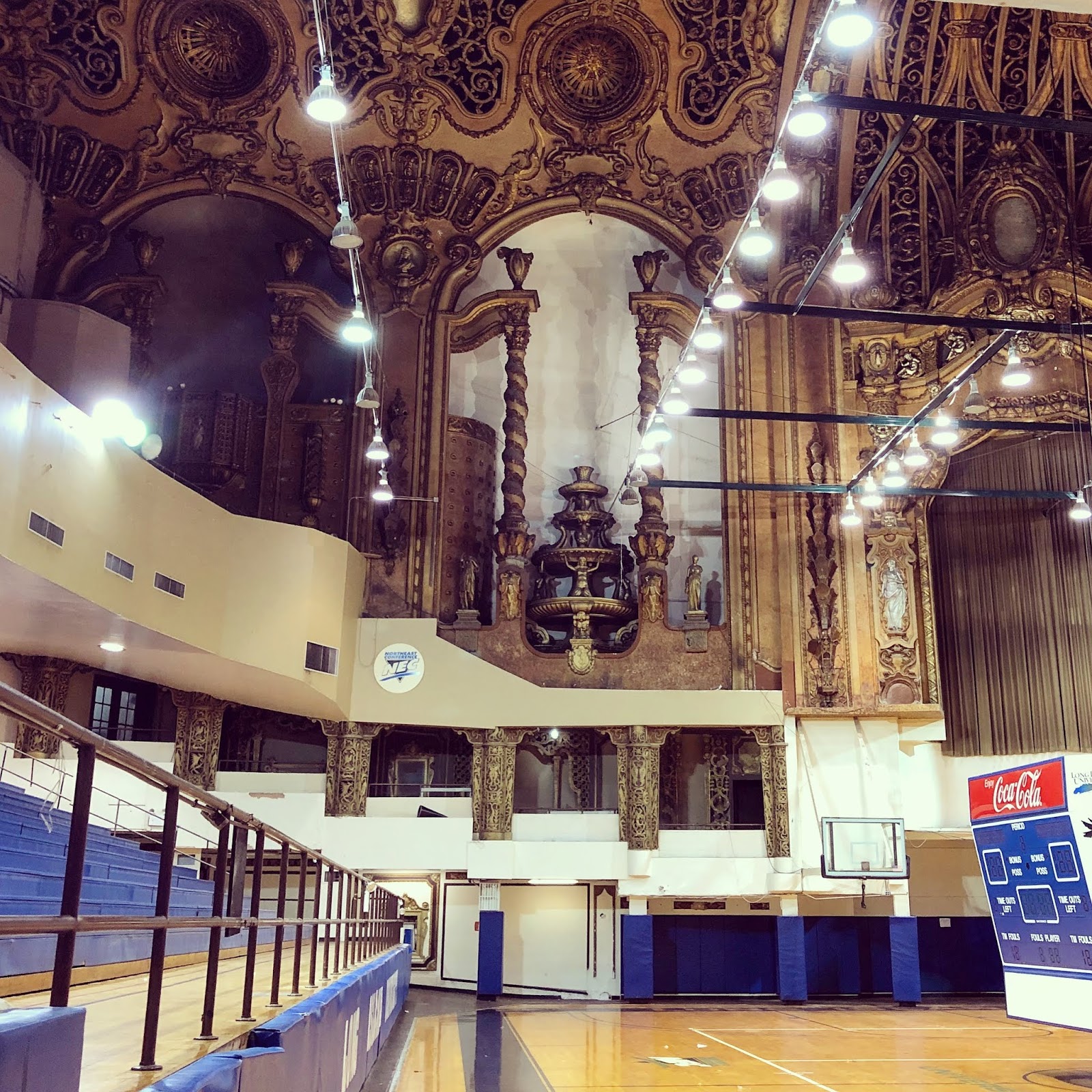
Perhaps the fanciest basketball court in the city was carved out of Brooklyn's Paramount Theatre in Fort Greene in the 1960s and is now home to the LIU Brooklyn Blackbirds, 


Kingsland Wildflowers, in Greenpoint, Brooklyn, converted an industrial rooftop into a field of wildflowers native to New York City to attract pollinators. Cast against the silver digester eggs of the Newtown Creek Wastewater Treatment Plant, the scene presents an eerie hybrid of wild and industrial rarely found in the city.


CW Pencil Enterprise on the Lower East Side proffers iconic New York City colors in pencil form: SoHo Scaffolding, City Bike Lane, Taxi Cab, F Train Seat, Street Pretzel, Bodega Mums, Harlem Brownstone, Manhattan Bridge, Asphalt, and Subway Station Tile.


I stumbled upon this mysterious find on the uptown 4/5 platform at Lexington and 59th Street: a vintage subway record book chronicling escalator repairs and a tiny green lock.

Thursday, June 6, 2019

TASTE: Chive momos at a secret Tibetan food counter

Much as snippets of chive are hidden within the folds of a momo, a dense Tibetan dumpling, the restaurant Lhasa Fast Food is hidden within a labyrinthine minimall in Jackson Heights. Though unmarked restaurants have become almost a cliché in 2019 New York City, in this case the restaurant’s reclusiveness does not seem intentional or subversive. There’s no dim lighting or velvet banquette to reward your sleuthing. In fact, Lhasa Fast Food’s ambience is as unassuming as its signature snack.


My first attempt to find the food stall led me into the mall and directly down a flight of stairs, where I was met with a store stripped of its contents but for some half-deflated party balloons and a sign for “New Jackson Tailors” and a striking couple in traditional Indian clothing. A mirror propped on a taped-together bureau revealed a reflection of several tailors sewing in a distant corner.


Heading back up the stairs and veering to the right, I stumbled upon a money transfer shop, a spice merchant, and a shoebox salon specializing in keratin treatments and eyebrow threading—two neighborhood specialties.


Turning around again and catching my reflection in the narrow glass-walled corridors, I passed You and Me Wireless, packed with customers brandishing their mobile devices, and Yamuna Jewelry (“Share Moments, Share Jewels”). At the end of a long, dim corridor was my first glimpse of Lhasa Fast Food:


The restaurant is all peeling tangerine paint and sky-blue ceiling, a shawl-draped portrait of the Dalai Lama, an American flag tucked into a plumbing pipe, a file cabinet holding utensils and a thermos of butter tea labeled with masking tape, and a security camera impaled through a banner of a Himalayan mountainscape. A flat-screen TV plays the YouTube music channel Tibetan HeartBeat. 


Finally, the chive momos arrive, six to a bamboo basket.

Each momo is crimped at the top and waves an infinitesimal flag of chive. When burst with the prong of a chopstick, they release a puff of steam and reveal a slick pile of chives. The only other ingredients, according to the menu, are oil and salt, but the flavor explodes on the tongue. The dough's pleats are thick and chewy, while the rest of the skin is nearly translucent and falls from the chopsticks. A squirt of fiery hot sauce provides the final touch. 


Paired with a bowl of salty, creamy, tangy butter tea from atop the file cabinet, the snack disappears.


Now it’s time to find your way home.


Lhasa Fast Food is located at 37-50 74th Street, in Queens.