A monthly blog about the sensory experience of New York City

Wednesday, February 5, 2014

SIGHT: Coney Island Polar Bear Club Sunday swim

It might not have been the coldest January day for a swim in the Atlantic Ocean, but though temperatures hovered in the mid-forties the wind was brisk, and the water, reportedly, was about ten degrees colder: around thirty-five degrees. On a recent Sunday in southern Brooklyn, members of the hundred-year-old Coney Island Polar Bear Club begin to file through a door in the Education Center of the New York Aquarium, just off the boardwalk. In the high season it appears to be a lifeguards’ locker room, but a placard affixed to the chain-link fence proclaims it the winter headquarters of the Polar Bears.


As the oldest winter bathing organization in the country, the club is predictably overrun with spectators and photographers, and the Polar Bears seem at peace with this dynamic: these are not shy New Yorkers, after all. The demographic seems to consist mostly of older men, but includes a surprising number of women, and even some children with their parents. No one seems to be vain: many bodies are well padded, and bathing suits tend toward the saggy and threadbare. All the Polar Bears, however, wear protective footwear, usually surfing booties: the toes are first to succumb to the cold.


The beach today is empty save for seagulls, dog-walkers, a mother singing softly in Russian to her toddler, and a couple of wild-eyed treasure-seekers prowling the sands with metal detectors and shovels. The sky is dramatic: dark clouds pierced by brief shards of sun. You’d expect the Polar Bears to rush into the water during these breaks of warmth, but no, they are cooler than this. The president of the club, Dennis Thomas, a.k.a. “Mr. Freeze,” told me: “In the thirty years I have been swimming with the club, we have never canceled a swim due to the weather.”


Inside the locker room a cheer erupts, like a middle-school soccer team rallying before a game, and the Polar Bears file out through the door, cross the boardwalk, and parade down the windswept sand. They slap their bare torsos, hike up their string bikinis, engage in light calisthenics, and chat with friends as passersby in down coats and fur hats gape in awe and admiration from the boardwalk. Someone inevitably asks one Polar Bear how long she has been at this. “Years. I don’t know, years!” she says, with a characteristic blend of gruffness and affability. “You ever been in? Well, it’s a thrill.”


At the water’s edge, someone barks, “Okay, circle up!” and leads the group in jumping jacks and a ritual chant. Then the eighty or so Polar Bears storm into the waves, whooping and yelling. I hear no complaints of the cold and see no signs of fear, only pure exuberance. Once they’re all in the water, they circle up again and, holding hands, paddle around in a circle, tossing a ball between them. “Yaaaaaah!” “Whooo-whoooo!” they cry. No one seems eager to get out.


Finally the Polar Bears emerge from the water. Two old men with sagging bellies hold hands. “Your legs all right?” one asks the other. “They’re workin’! They’re workin’!” his friend insists.


I decide to wade in. I remove my snow boots and wool socks and tiptoe to the water’s edge across the glacier-like sand. A wave laps toward me, washing over my toes and instantly numbing them. My calves begin to quiver as I await the next wave, and this time I’m ready. It is exhilarating—already I feel refreshed, like the day has begun again. I realize I’m a long way from becoming a club member: you have to complete twelve swims on one season to gain admittance to the club. The youngest member ever to join was nine years old.


    “I’m awake now!” one woman cries, raising her arms to the sky.
    “My dingo shrunk in the water today, eh?” one old man remarks, chuckling, as he reaches for his robe.


A woman next to me is standing in the sand, still in just her suit, seemingly impervious to the cold as she gazes toward the winter ocean. Her legs look pink. I ask her how it went today. “You’re expecting it to be cold, you know? So it’s okay. It gets the endorphins going, clears the system. We get so overheated inside in the winter in the city.” She wiggles her toes in her surf booties. “Okay, I’m gonna go get my robe now.” 


Tuesday, January 7, 2014

MULTISENSORY: New York City shoeshine

It’s the aftermath of the New Year’s snowstorm, and in annual Sense & the City tradition, I need to cleanse my senses for the year ahead. This year’s mission: a genuine New York City shoeshine for the boots that have taken me on so many adventures across the five boroughs. These boots, about twelve years old, have been resoled and restitched countless times. In this city, walking is a sense in its own right, and shoes need regular cleansing for the rigors of sidewalks and subways.


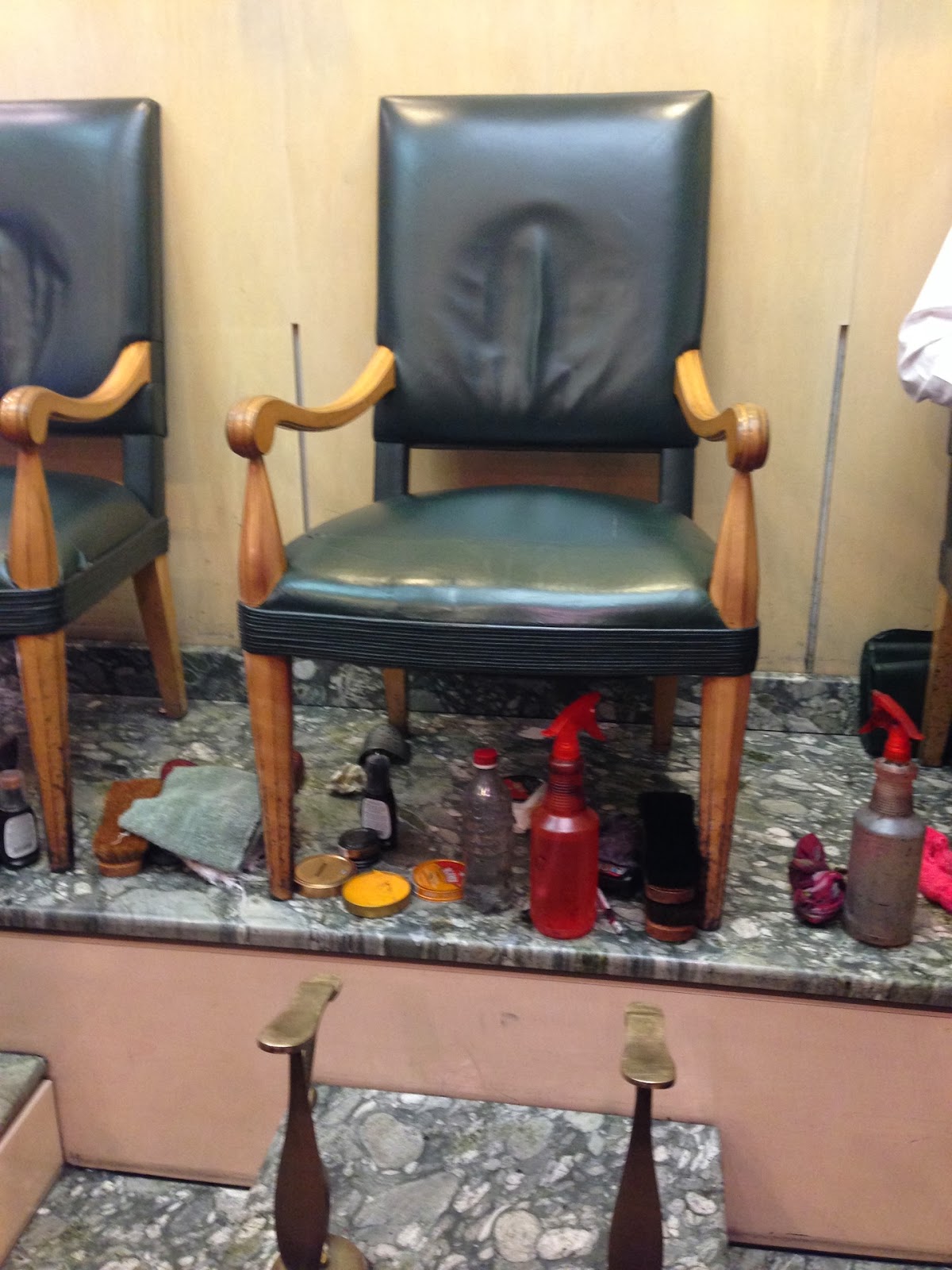
Perhaps because of this, the subway shoe-shine is a quintessentially New York experience, from the hole-in-the-wall Lexington Express Barber Shop & Shoe Repair, hidden around a narrow bend in the Eighty-Sixth Street station, to the Jimmy Choo–stacked windows of Angelo’s Leather Care, just before the turnstiles at Fifty-Third and Fifth. For its ordinariness, I chose the Rockefeller Center branch of Eddie’s Shoe Repair. (Eddie’s also has a shop in Grand Central Terminal, featuring brass-and-leather thrones on wood-and-marble pedestals.)


Coming in from the slushy streets, my boots are met with concern as soon as I place them onto the brass shoe rests. My bootblack (as polishers are traditionally called) points to the wet spots and waves over the manager. They prod and shake their heads. “These parts won’t take a shine, ma’am,” the manager says. I tell him not to worry. “You just wanna spruce ’em up, eh?” He smiles. I settled back into the armchair. The podium is scattered with the tools of the trade: tins of polish, stained rags, spray bottles, brushes.


As my bootblack rolls up my cuffs and sprays the boots with a vinegary desalting mist, I settle back into the armchair. The buzz of MSNBC on a flat-screen contrasts with the whish of brushes as the other bootblacks work on drop-off shines. Tourists in snow boots and animal-head ski hats clomp past the windows through the underground concourse. He smears the boots with a leather conditioner, working it into lather with an old toothbrush. I can feel the bristles massage through the leather, into the arches and over my anklebone.


He cradles my foot in the crook of his elbow and uncaps a tin of polish with a pop. The room smells creamy and acidic: of wax and vinegar, leather and soap. As he twists a rainbow-smeared cloth into a knot around his index finger and dips it into the cake of polish, I can almost feel the wax softening and cracking.


A businessman walks in, and the manager barks, “Next!” One of the bootblacks stands to attention, ushering the man into his chair, and drops a New York Post onto his lap. The man unfurls his ear buds while the bootblack wraps masking tape around the buckles on his loafers. My bootblack picks up a boar-bristle brush and descends on my boots from a great height, his hands a blur of motion as the toes began to gleam beneath his whacks. 


The final step is a walloping with a terry towel, which makes a satisfying slapping sound. He pulls it along the heels and up and down my calf like someone drying off their back with a bath towel.


And what can beat the synchronicity of sounds, smells, and the ritualized motions of an in-person shoeshine in a subway tunnel on a dreary city afternoon—all for about the price of subway ride?


Wednesday, December 4, 2013

SIGHT: Blind dining at Camaje

“My eyes are getting hot in this blindfold. Can you fan me?” I heard one of my fellow dinner guests ask her date. In the distance, a woman was insisting to the maître d’, “I eat fish but not fish in things. Absolutely no cream sauce. Oh, and I’m gluten-free.”


We were standing outside Camaje, a West Village bistro, waiting to place our hands on a stranger’s shoulders and be escorted over the threshold for a four-course “dinner in the dark.” Just moments before we had been handed our deluxe blindfolds (which featured inlets to accommodate eyelashes). As my companion and I fastened the Velcro around each other’s heads, we realized how much trust we were putting in our hosts, and in our fellow New Yorkers. 


One might expect that, at a blindfolded meal, the four other senses would be heightened. This, however, was not our experience. The menu was revealed only at the end, and we were shocked to realize how often we had misidentified the food, and how much taste depends on sight. What tasted like tomato soup turned out to be leek and cauliflower; what smelled like white wine turned out to be red. Perhaps because our senses of taste and smell seemed dulled, both my companion and I felt desperate to touch things. As soon as I was led to my seat I found myself groping around, and was relieved to find a wall to my left and my companion’s knees under the table.


We quickly abandoned our flatware, finding it more satisfying to eat with our fingers. Somehow raising an unknown food to one’s lips on the end of a fork required too big a leap of faith: through touch we could gain some sense of the food’s texture, temperature, size, pliability. At one point I jabbed my fork toward my plate and was astonished by its weight when I lifted it up. I bit cautiously: a whole sweet potato. 


As we were encouraged to do, we tried feeding each other everything from wine to salad, aiming our utensils blindly across the table. We also fed each other with our hands, fumbling first to find each other’s mouths, but somehow this gesture felt too forceful. At one point a server came around and gave me a gentle and thrilling shoulder rub, though it would have been unwelcome in another context. Somehow, much like at a doctor’s office, we stopped caring what the wait-staff thought of us as we entered our own dark worlds more completely over the three-hour meal.


At restaurants it’s easy to be distracted by the conversation of the diners around you, but because we couldn’t see anyone we found it was impossible to eavesdrop. By contrast, our own conversation seemed especially focused and intimate, though if there was a pause we both felt unmoored. Between courses, musicians performed on unidentifiable instruments, and we could hear pots and pans clattering in the kitchen behind us. We experimented with blind lip-reading (a test of intuition), then attempted to read each other’s lips pressed into our hands, Helen Keller–style. Each sound, taste, smell, and texture—though muted—used up a moment in its entirety. We were more present for this meal than we had been for any meal in a long time. 


The staff also encouraged us to take photographs, so with some assistance navigating my phone, I took blind photos of my surroundings. Emerging back onto the sidewalk at the end of the evening, I was astonished to realize how small the room had been, and how bright. I also noticed that the room was hung with mirrors, witnesses to twenty or so New Yorkers unexpectedly blessed with vulnerability and presence. 


Tuesday, November 5, 2013

SMELL: CB I Hate Perfume

Instead of perfume, I prefer the changing scents of my experiences in the city to permeate my day. When I heard about CB I Hate Perfume’s scent library, where one can linger, pressing one’s nose into the tops of hundreds of glass vials containing the scents of seasons, memories, daily tasks, even emotions, it seemed I had found my perfume mecca.


According to the sales clerk, the store was started by a former taxi driver, Christopher Brosius (CB), who was revolted by the medley of cloying perfumes and odors that mingled in his cab. He decided to create an antidote, hence the store’s name. On a business card available at the counter, a quote from CB reads: “Perfume is too often an ethereal corset trapping everyone in the same unnatural shape… an arrogant slap in the face from across the room… People who smell like everyone else disgust me.”


The narrow storefront, in north Williamsburg, is spare and inviting, with a nose-level “library” of single-note scents arranged by category—from “Water” to “Skin,” “Smoke” to “Clean”—and quotes from literature elaborating on each theme. Scents from this library are combined into the ready-to-wear perfumes that line the opposite wall, with names like “In the Summer Kitchen,” “Gathering Apples,” and “Burning Leaves.” These fit into existential categories, like “Experience,” “Secret History,” “Reinvention,” and “Metamorphosis.”
 

I decided to dip my nose into the “Clean” section, which contained a manageable number of bottles. A brief quote from Colette introduced the collection: “That sugary smell of new blue cottons.” The scent “Eucalyptus Leaf” brought me straight to the Tenth Street Baths’ sinus-clearing steam room.


“White Camphor” was like the inside of your grandparents’ medicine cabinet. I had expected sweat and floor cleanser in “Locker Room” but instead got the mingled fragrances of shampoos and deodorants. “Clean Sheets” evinced just that: downy, pillowy, inviting, and even suggested a breeze through a screen window. “White Soap” contained the aroma of a Dove bar, with its creamy edges softening beneath the fingers. It was hard to know what to expect from “Plain Old Soap,” but to me it smelled like the paper-wrapped kind found on the bottom shelf of a bodega. “White Pine” was the redolence of pine floor soap, to some the epitome of “clean.” “Beautiful Launderette” was more floral than I’d expected: like the scent of dryer sheets that wafts from Laundromat vents. I had to ask the clerk about the last scent, “Ozone Air,” but he pinpointed it as the sweet smell exuded by photocopy machines. I’m not sure why that smell is “clean,” but nevertheless it was spot-on.


Moving across the room to the ready-to-wear scents, I selected “November.” The store describes it as “pumpkin pie, fallen apples, bonfire, wood smoke, dried grass, fallen leaves, wet branches, damp moss, chanterelle mushrooms, and a hint of pine forest.” Unfortunately, to me it smelled like a Christmas Tree Shoppe: potpourri and “apple pie” scented candles mixed with pine room spray.


A few weeks later, I found myself taking a taxi uptown to a dinner party, an apple-rosemary pie on the seat beside me. Needless to say, I sniffed to see if I could discern the inspiration for CB I Hate Perfume. This cab smelled like a just-uncapped stick deodorant, a ladies’ dressing room in a department store, the vinyl of the seat upholstery, with an undercurrent of cigarette smoke. Through the cracked window came the chill air of a November night. The once-fragrant pie beside me was no competition for these smells of the city.