A monthly blog about the sensory experience of New York City

Showing posts with label sight. Show all posts

Tuesday, November 23, 2021

SIGHT: Mariners Marsh Park: the eeriest place in New York City


Just a few days after Halloween, I headed to Mariners Marsh Park, in the northwest corner of Staten Island, for a solo autumn leaf-peeping hike. I soon found myself in one of the eeriest and most beautiful places I've encountered in the five boroughs. The park comprises 107 acres of pin oak forest, ten ponds, and wetlands. But hidden among the trees and marsh grasses are ghostly remains of the factories once located on this land (and, according to the New York City Parks website, Lenape Indian artifacts). I couldn't help feeling like I was trespassing as I squeezed through a gate rigged to admit only the most determined of explorers.

The park has been closed to the public since 2006 for an environmental investigation. In the 1900s, the land was home to an ironworks and, later, a shipbuilding foundry. The ponds that now reflect the autumn sky were man-made and were used by both industries. Beneath their serene surfaces lurk hazardous chemical residues; a few backhoes and piles of sandbags on their shores indicated that the area is being remediated. But on the day I visited, the machinery was silent. Rusted rain tracks appeared from the underbrush, leading into a tangle of vines. 

As I walked alongside the rails, I heard a ghostly whistle and clanging in the distance. Peering through a chain-link fence, I saw a modern freight train lurching past, spattered with graffiti spelling out "DO IT." The freight line of the Staten Island Railway skirts the southern end of the park, but this train seemed to be slicing through the wilderness.

In spots, the disused trail dissolved into a tunnel of vines; I had to duck to move forward, and despite the whine of the train, I felt impossibly far from humanity. If something happened to me, who would know? 

There were signs of past visitors, however: rusted beer cans and even discarded clothing, seemingly belonging to a child.

Though there are official trails, the signs are sparse and faded. I trusted my innate sense of direction (Google Maps was not much help), following vague turns, until I stumbled upon concrete mounds rising out of the leaf litter like the remains of a fortress from an ancient civilization.

One section of wall had windows looking out on the underbrush.

A section of brick wall lay atop the fallen leaves as if dropped from above. 


I bushwhacked through tall grasses, mud squelching underfoot, trying to recover the trail. After ten minutes of guessing which turns to take, Monument Pond appeared through the rushes, a serene pool reflecting the sky and treetops.

On the shore were more ruins.


Suddenly, I spotted a slice of vivid pink through the trees. As I got closer, I saw it was a bird-spotting blind, the viewing holes transformed into the vacant eyes of a painted crocodile, like a carnival photo prop. The blind was in a clearing with picnic tables. Birdhouses swung from the trees. No one was in sight.


A four-pointed buck leaped out of the woods, stared at me, and disappeared, too fast for me to take a photo. Was it a ghost? Against the autumn sky, the phragmite stalks waved in the wind.


Friday, November 20, 2020

SIGHT: The Most Socially Distant Spot in New York City

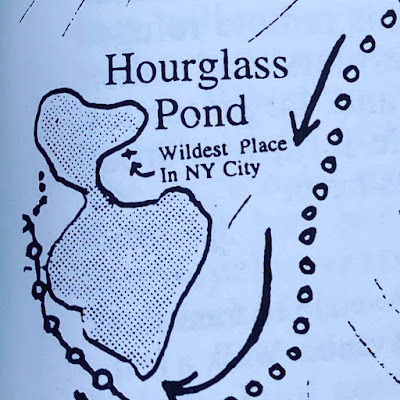
According to naturalist and native Staten Islander Bruce Kershner, author of the book Secret Places of Staten Island, the wildest place in New York City is on the northern edge of Hourglass Pond, in the middle of the Staten Island Greenbelt. Kershner defines "wildest" as "that natural point of land (not water or marsh) that is the most remote from streets and homes," two conventional markers of civilization. When you are standing at this place in the forest, he claims, the nearest street or home is 1,700 feet to the east or west; 3,200 feet to the north; and 2,500 feet to the south: in other words, many multitudes of six feet away. 

Detail of map from Secret Places of Staten Island

One recent afternoon, I decided to leave behind the urban landscape of "six feet apart" floor stickers and feet spray-painted on sidewalks and follow Kershner's arrows to make my own footprints in the local forest. How would it feel to be optimally socially distant from other New Yorkers?


With Kershner's book in hand, I followed his turn-by-turn directions and yellow and blue tree blazes into High Rock Park. After passing a few hikers and one mountain biker, I was alone with the crunch of leaves, the distant whishing of the Staten Island Expressway, and the drone of an occasional airplane. Prickly chestnuts plopped onto the path. Squirrels chattered. The wind sighed through branches.


But although there were no streets or homes within sight, signs of humanity—and reminders of current global events—continually emerged among the trees. 


Prior to this hike, I'd consulted ecologist Rebecca Means, the cofounder, along with her husband, of Project Remote. Together with their young daughter, they are mapping the most remote spot in each state and enlisting citizen scientists to record other remote places. When I asked her where that place in New York City might be, she said she didn't have that data yet, but offered these thoughts: "How you define 'remote' definitely matters! There are many definitions... and where you want to travel to be remote depends on what kind of remoteness you are seeking. Is it distance from services? people? roads? cities? human structures? trails? Also, does the spot have to be on land (inhabitable), or can it be in the middle of a lake or ocean? The other side of this, when seeking remoteness, is what you can actually measure. There are not data for every foot trail and human structure or sound, so that complicates your ability to say you are far from those variables."


About ten minutes into the hike, the trail skirted a cemetery, its monuments festooned with flowers and American flags. Dump trucks trundled mounds of fresh dirt. A sedan pulled up and a hunched man in a face mask got out and shuffled toward a grave, where he stopped and bowed his head.


A few minutes later, I glimpsed a strip of bright green beyond the tree trunks and heard the drone of a lawnmower. It turned out to be a golf course, with the Brooklyn skyline hazy in the distance.


A little farther on, along the shores of a lake, the darkened lean-tos of a camp belonging to the now-scandalized Boy Scouts lurked through the trees. 


Triangulating between Kershner's book, Google Maps, and a Greenbelt trail map, I scrambled downhill and came upon a fallen tree. With its X shape, I decided it unofficially marked the most socially distant spot in New York City. 


I sat down and watched stately Canada geese drifting past on Hourglass Pond, whose name seemed fitting for autumn 2020, with its surging death tolls and countdown to a new administration. From this spot, there was no sign of cemeteries, lean-tos, or golf courses. Wild woodland and glassy ponds stretched far in every direction.


As Rebecca Means pointed out, "No matter how you define 'remote,' it is an adventure trying to get there"—especially in the middle of one of the largest cities in the world.


Monday, December 16, 2019

SIGHT: Secret Christmas tree memorial for departed pets

It could take hours to find—or minutes, if you happen upon the right sequence of paths in the labyrinthine Ramble of Central Park


At first it's just a flutter in the corner of your eye, a pattern to the light. Then it emerges from behind a tangle of bare branches: an ordinary evergreen tree, not too different from the two trees flanking it, except that on Sunday in mid-December, it seems to be receiving an unusual number of visitors.


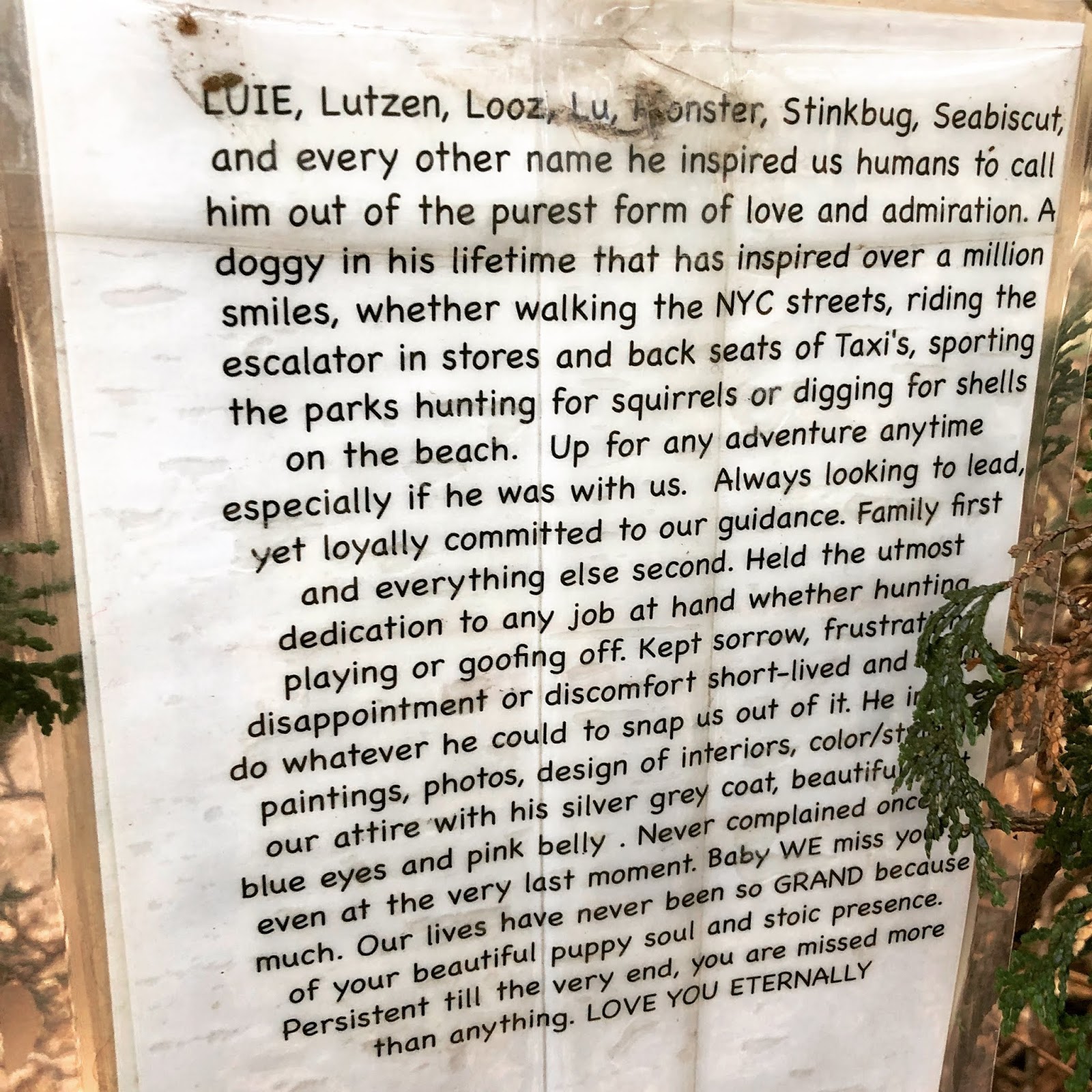
Get closer still, and you'll see why. The tree is bedecked in dozens of Christmas ornaments. Upon closer inspection, you'll notice that most of the ornaments are homemade and are dedicated to pets who have died. Photos of each animal have been laminated and strung with ribbon or encased in Ziploc bags to protect them from the weather.


There are dog treats for good behavior in heaven,


a beribboned collar as a reminder of favorite city walks,


or a bit of honey for the afterlife.


There are curious talismans, including one made of hair, glitter, and ribbon—with a checkered taxicab theme.


There are no backyard chickens or urban sheep. Ming the tiger, who was raised in an apartment in a Harlem housing project and died this autumn, has not yet been commemorated. Most of the pets are cats or dogs, but there are a few outliers: a bunny named Winnie,


a box turtle named Sherman,


and a budgie named Buddha.


Some of the ornaments are simply a photo and a Sharpied name. But others have odes to the lives of pets in the heart of a big city.


I had brought with me an ornament—laminated for free by a sympathetic Print Services worker at Staples—memorializing our family's two goldfish, Ralph and Frank. They turned out to be the only fish on the tree.


As I walked away, I heard the plastic ornaments rattling against one another in the breeze. In this secluded grove in one of the few wild places left in Manhattan, these homemade offerings provide an intimate glimpse into the lives, apartments, and hearts of New Yorkers and of the creatures who offer them unconditional love and predictability in an unpredictable city.


The location of the pet memorial tree is kept a secret by its keepers, but if you are lucky you may stumble upon it during a stroll through the Ramble.


Wednesday, August 7, 2019

SIGHT: The weed-eating goats of Riverside Park


One recent weekday morning, a group of goat enthusiasts gathered at the intersection of Riverside Drive and 120th Street to see five of their favorite ungulates compete for the title of “Greatest Of All Time” (G.O.A.T.). A balloon-bedecked fence separated the crowd from the goats, who were up on their hind hooves trying to reach the shrubbery of Riverside Park, which was, for now, tantalizingly out of reach.


After the awards ceremony, the top four goats would be led from the podium, through a gate, and into a two-acre enclosure, where they would spend the next month munching 25 percent of their body weight in weeds each day and revitalizing the soil with their droppings. 


The fifth-place contestant would be returned to its home pasture in Rhinebeck, New York. As the park has learned, there is not enough Japanese knotweed, poison ivy, or porcelain berry to sustain more than four goats at a time. Massey, Bella, Skittles,  Chalupa, and Buckles were selected through a public “Vote the Goat” election (there’s also a “Goat Fund Me” site) from an original group of twenty-four; three thousand online ballots were cast. 


The goats debuted in Riverside Park in May 2019 as an experiment in natural, sustainable invasive-weed management called “Goatham City.“ They quickly became a local sensation.


Goat puns abounded in the opening remarks—with a little soapboxing about paid family leave and marijuana legalization. Dan Garodnick, president and CEO of the Riverside Park Conservancy, presided. George Shea, the emcee of Nathan’s Famous International Hot Dog Eating Contest, certified each goat’s consumption performance. “We hired some of the most active, ambitious, and hungry summer interns and a full-time professional weeding staff,” Garodnick announced, gesturing to the goats. One of the conservancy’s human interns, Nina, in a tiara and gown, beamed from the sidelines. 


The goats were now trying to hurl themselves out of their pen. “You have goat to come down here,” joked councilmember Mark Levine, indicating the goats’ future home. “The weed situation was baaad.” In fact, the twenty-four original goats had been so effective—each goat ate about one thousand pounds of weeds over the spring and early summer—that they had to be sent home to give the weeds time to redevelop. 


Finally, the goats were led to the podium by handlers wearing flower crowns. Nina the intern draped medals around their necks, Shea certified each animal as a champion eater, and they were presented with golden goat trophies and bouquets of weeds. Ten-year-old, 166-pound Massey from Massachusetts was pronounced the “G.O.A.T.” and, after making short work of her bouquet, dragged her handler to a table decorated with hay bales.


At last, the goats were released to the hillside. A guy in an I LOVE GOAT YOGA tank top snapped photos. A little boy holding a stuffed goat watched the animals tackling the weeds. 


“One day I want to do a human-versus-goat eating contest,” Shea told a member of the press. He didn’t clarify if the food of choice would be hot dogs or poison ivy.


Monday, July 8, 2019

SIGHT: Seven sights for the seventh month

In Sense & the City tradition, I present seven of my favorite sights from the past year in honor of the seventh month.


Only in New York would there be a line to get into a laundromat. The Cornelia Street Laundromat must be a pretty special place to wash clothes.


A visit with ninety-five-year-old grocer John Cortese at his Golden Gate Fancy Fruits and Vegetables is always worth the trip to Flatlands, Brooklyn.


Barkaloo Cemetery, the smallest graveyard in Brooklyn, features only two graves (the others are monuments), and is wedged between a shady side street and a school bus depot.


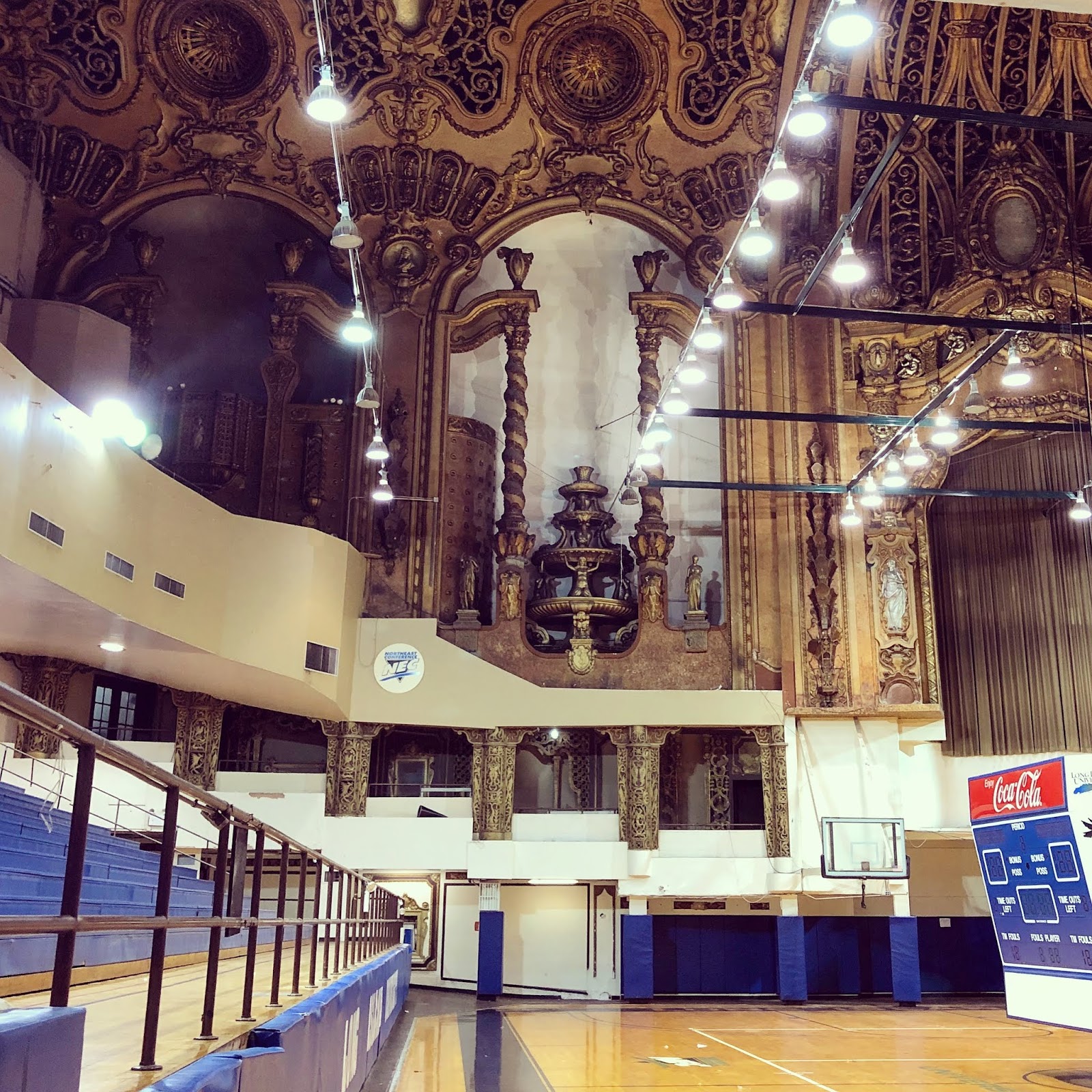
Perhaps the fanciest basketball court in the city was carved out of Brooklyn's Paramount Theatre in Fort Greene in the 1960s and is now home to the LIU Brooklyn Blackbirds, 


Kingsland Wildflowers, in Greenpoint, Brooklyn, converted an industrial rooftop into a field of wildflowers native to New York City to attract pollinators. Cast against the silver digester eggs of the Newtown Creek Wastewater Treatment Plant, the scene presents an eerie hybrid of wild and industrial rarely found in the city.


CW Pencil Enterprise on the Lower East Side proffers iconic New York City colors in pencil form: SoHo Scaffolding, City Bike Lane, Taxi Cab, F Train Seat, Street Pretzel, Bodega Mums, Harlem Brownstone, Manhattan Bridge, Asphalt, and Subway Station Tile.


I stumbled upon this mysterious find on the uptown 4/5 platform at Lexington and 59th Street: a vintage subway record book chronicling escalator repairs and a tiny green lock.